
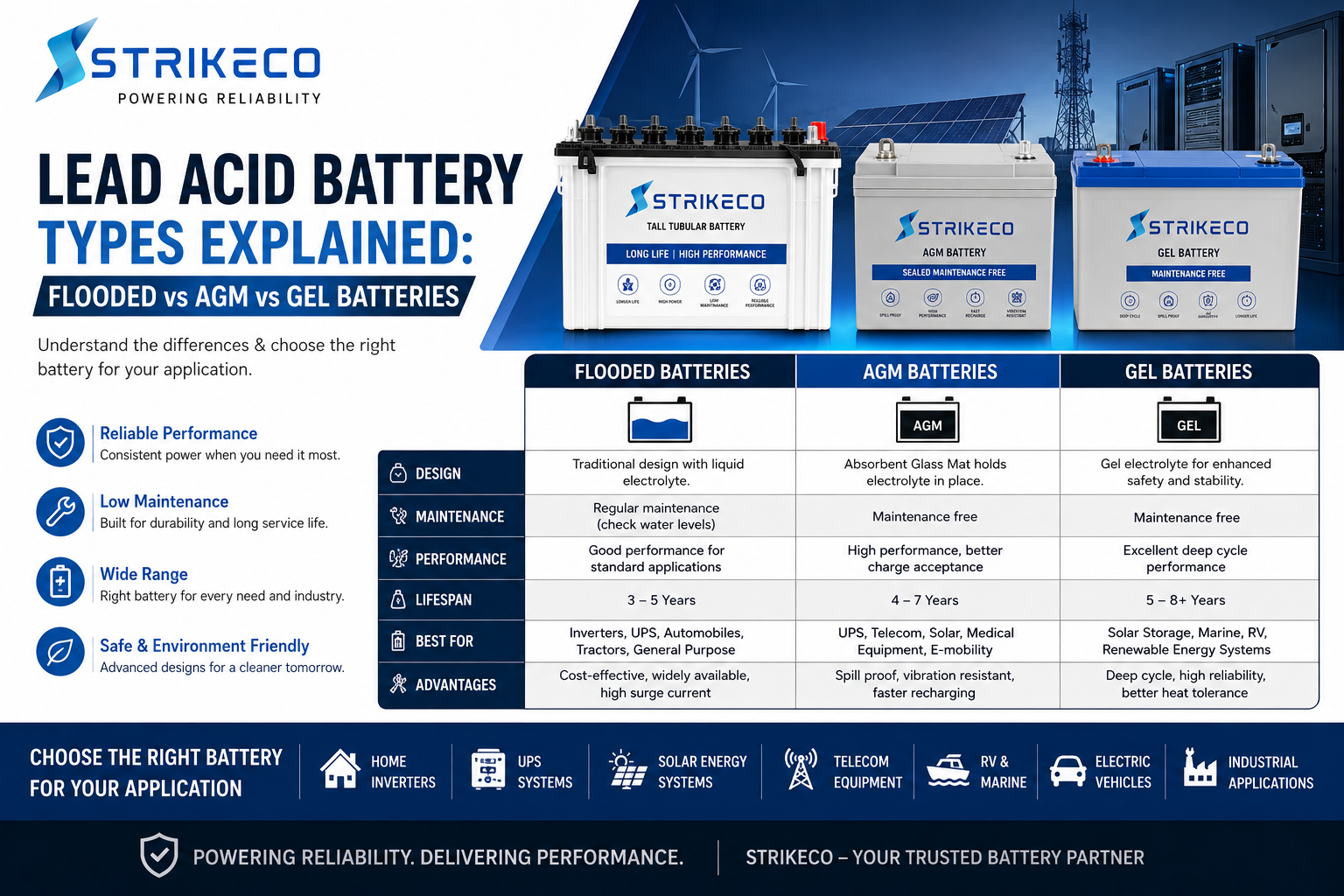
Lead Acid Battery Types Explained: Flooded vs AGM vs Gel Batteries
Lead acid batteries are available in several designs, but the three most common types buyers compare are flooded lead acid, AGM, and gel batteries. All use lead-based electrodes and sulfuric-acid electrolyte, but they differ in how the electrolyte is contained, how they are charged, how much maintenance they require, and the applications for which they are best suited.
There is no single lead acid battery type that is best for every application. Flooded batteries are often suitable when cost and serviceability matter and regular maintenance is practical. AGM batteries are commonly chosen for low-maintenance applications requiring strong current delivery and vibration resistance. Gel batteries can suit selected deep-cycle, standby, and demanding operating environments where their particular charging and cycling characteristics are beneficial.
Understanding these differences helps buyers select the right battery for UPS systems, inverters, solar installations, industrial equipment, mobility applications, and backup-power systems.
What Are the Main Types of Lead Acid Batteries?
Lead acid batteries can broadly be divided into flooded and valve-regulated lead acid (VRLA) batteries. Flooded batteries contain freely flowing liquid electrolyte, while VRLA batteries immobilize the electrolyte and use pressure-regulating valves. AGM and gel are the two major VRLA designs.
The main types are:
- Flooded Lead Acid (FLA): Traditional wet-cell design with liquid electrolyte.
- AGM (Absorbent Glass Mat): Electrolyte is absorbed into fiberglass separators.
- Gel: Electrolyte is immobilized by adding a silica-based gelling agent.
- VRLA: The broader category that includes AGM and gel technologies.
Although AGM and gel are sometimes described simply as “sealed lead acid batteries,” they still incorporate pressure-relief valves and have specific charging requirements. They should therefore not be treated as identical technologies.
Buyers comparing different capacities and configurations can also explore available lead acid battery products according to their application requirements.
What Is the Difference Between Flooded, AGM, and Gel Lead Acid Batteries?
The biggest difference is how the electrolyte is stored. Flooded batteries contain liquid electrolyte, AGM batteries absorb electrolyte into fiberglass mats, and gel batteries immobilize it in a gel. This affects maintenance, charging, spill resistance, current delivery, cycling characteristics, installation flexibility, and cost.
| Factor | Flooded | AGM | Gel |
|---|---|---|---|
| Electrolyte | Liquid | Absorbed in glass mat | Gelled |
| Category | Conventional flooded | VRLA | VRLA |
| Routine watering | May be required | No | No |
| Spill resistance | Lower | High | High |
| High-current performance | Good, design-dependent | Very good | Generally lower than AGM |
| Charging sensitivity | Moderate | More sensitive | Particularly requires correct charging profile |
| Installation flexibility | Usually upright | More flexible | More flexible |
| Initial cost | Often lower | Usually higher than flooded | Often higher |
| Maintenance requirement | Highest | Low | Low |
| Common uses | Inverters, solar, industrial, motive | UPS, backup, vehicles, equipment | Deep-cycle and selected standby uses |
AGM has particularly low internal resistance and strong current-delivery capability, whereas gel batteries generally have higher internal resistance and are less suited to very high-current applications.
How Does a Flooded Lead Acid Battery Work?
A flooded lead acid battery uses lead-based positive and negative plates immersed in a liquid electrolyte made from sulfuric acid and water. During discharge, chemical reactions generate electrical energy; charging reverses those reactions. Because the electrolyte is liquid, conventional flooded designs require ventilation and may require periodic water-level maintenance.
Flooded lead acid is one of the oldest and most widely established rechargeable battery technologies.
When Should You Choose a Flooded Battery?
Flooded batteries can be appropriate when:
- Regular maintenance is practical
- The installation has proper ventilation
- Initial purchase cost is important
- The battery will be used in cyclic applications
- Installation orientation is controlled
- Service personnel can inspect electrolyte levels
Deep-cycle flooded batteries are used in applications involving repeated charge and discharge, including renewable-energy and motive-power applications.
A flooded battery may therefore work well for certain inverter installations, industrial equipment, solar systems, and other applications where maintenance access is not a problem.
The trade-off is that the user must follow appropriate inspection, watering, charging, ventilation, and maintenance procedures.
What Is an AGM Battery?
AGM stands for Absorbent Glass Mat. In an AGM battery, the sulfuric-acid electrolyte is held within fiberglass separators between the battery plates. AGM is a VRLA technology that provides low maintenance, high current delivery, good vibration resistance, and reduced risk of electrolyte spillage compared with conventional flooded designs.
One of AGM’s biggest advantages is its relatively low internal resistance.
This allows AGM batteries to deliver high currents when required, making the technology useful for applications where substantial short-duration power may be needed.
When Should You Choose AGM Over Flooded Lead Acid?
AGM may be preferable when:
- Routine watering is undesirable
- The battery is installed in equipment exposed to vibration
- Strong current delivery is needed
- Installation space or orientation is restrictive
- Reduced electrolyte-spill risk is important
- The application involves UPS or standby power
- Maintenance access is difficult
Common AGM applications include UPS systems, vehicles, motorcycles, marine equipment, robotics, backup systems, and selected deep-cycle equipment.
For example, consider an industrial UPS installed in an electrical room where dozens of batteries are used in a bank. Eliminating routine electrolyte topping can simplify maintenance considerably compared with conventional flooded batteries.
However, this does not mean AGM is always superior. Flooded batteries can remain economically attractive when maintenance facilities and trained personnel are available.
What Is a Gel Battery?
A gel lead acid battery is a VRLA battery in which silica or another gelling material is added to the electrolyte, turning it into a semi-solid material. Gel batteries offer low maintenance and spill resistance and can perform well in selected cyclic and higher-temperature applications, but they require an appropriate charging profile.
Gel batteries have been widely used for standby, telecommunications, UPS, mobility, and other specialized applications.
Their advantages can include:
- No routine watering
- Good resistance to electrolyte leakage
- Good cycling capability in suitable designs
- Suitability for selected deep-discharge duties
- Greater installation flexibility than conventional flooded batteries
However, gel batteries also have limitations.
They generally have higher internal resistance than AGM and therefore are usually less suitable where exceptionally high current delivery is the primary requirement. They are also sensitive to incorrect charging and should be paired with equipment designed for their charging characteristics.
AGM vs Gel: What Is the Main Difference?
Both AGM and gel are VRLA technologies, but AGM holds electrolyte inside absorbent fiberglass mats, while gel batteries immobilize electrolyte using a gelling agent.
AGM generally provides lower internal resistance and stronger high-current performance. Gel can offer attractive cycling characteristics in suitable applications but is typically less suited to high-current loads.
For example:
Choose AGM when a UPS requires strong discharge performance during a power failure.
Consider gel when cycling performance and the application’s environmental conditions favor gel technology and the charging system supports it correctly.
The actual decision should still be based on the manufacturer’s datasheet rather than technology name alone.
Which Lasts Longer: Flooded, AGM, or Gel Batteries?
There is no universal answer. Battery life depends on battery design, depth of discharge, charging quality, operating temperature, discharge rate, maintenance, storage conditions, and application. Comparing “flooded vs AGM vs gel lifespan” without specifying these conditions can be misleading.
A well-maintained flooded deep-cycle battery can provide strong service in an appropriate application.
AGM eliminates watering requirements and can offer better cycling capability than conventional flooded designs in some use cases. Battery University also notes that gel designs can offer high cycle counts in suitable applications.
However, actual life can fall significantly when batteries experience:
- Repeated excessive discharge
- Chronic undercharging
- Overcharging
- Excessive heat
- Incorrect charging voltages
- Long periods in a discharged state
Instead of asking only “Which battery lasts longest?”, ask:
“Which battery provides the appropriate cycle life under my expected depth of discharge, temperature, charging system, and operating conditions?”
That question produces a much more meaningful comparison.
How Do Flooded, AGM, and Gel Batteries Compare for Charging?
Flooded, AGM, and gel batteries should not automatically be charged using identical settings. AGM and gel technologies have specific voltage limits, and incorrect charging can reduce battery performance or service life. Always follow the battery manufacturer’s recommended charging voltage, current, temperature compensation, and charging stages.
This matters especially when replacing one battery technology with another.
A charger designed for a flooded battery should not automatically be assumed suitable for AGM or gel simply because all three are lead acid batteries.
Battery University specifically notes that AGM and gel are not direct charging replacements for flooded batteries because their charge-voltage requirements differ.
Buyers can therefore evaluate a compatible lead acid battery charger together with the battery instead of treating the two purchases separately.
For more detailed technical background on AGM and gel lead acid technology, the independent educational resource Battery University’s guide to lead acid batteries provides additional information on their construction and charging characteristics.
Flooded vs AGM vs Gel: Maintenance, Cost and Performance Comparison
A simple way to compare the three technologies is to consider the complete operating requirement rather than purchase price alone.
| Selection Factor | Flooded | AGM | Gel |
|---|---|---|---|
| Initial price | Often lowest | Moderate/higher | Often higher |
| Routine watering | Usually required | No | No |
| Charging control | Important | More critical | Particularly important |
| High-current delivery | Good depending on design | Excellent | Moderate |
| Deep cycling | Good with deep-cycle design | Good with suitable design | Good in suitable designs |
| Vibration resistance | Moderate | Strong | Good |
| Spill resistance | Lower | High | High |
| Maintenance effort | Higher | Low | Low |
| Installation flexibility | Limited | Better | Better |
| Charger compatibility | Must be checked | Must be checked | Must be checked |
These are general characteristics rather than guaranteed performance specifications.
Two AGM batteries from different manufacturers, for example, may have substantially different cycle-life ratings, capacities, discharge characteristics, warranty terms, and recommended operating temperatures.
Always compare the individual product datasheets.
Which Type of Lead Acid Battery Should You Choose for Your Application?
Choose based on load profile, discharge depth, required cycle life, maintenance capability, operating temperature, current demand, available space, charging system, installation conditions, and budget. Battery technology should follow the application requirements rather than being selected solely because AGM, gel, or flooded technology appears more advanced.
A practical decision framework is:
Choose Flooded Lead Acid If…
Regular maintenance and ventilation are available, initial cost is important, and the application can accommodate a conventional wet-cell battery. Deep-cycle flooded designs can be attractive for inverter, renewable-energy, motive, and industrial applications.
Consider AGM If…
You need low maintenance, strong current output, good vibration resistance, reduced spill risk, or a compact solution for UPS, backup-power, automotive, mobility, or industrial equipment.
Consider Gel If…
You need a low-maintenance VRLA design for suitable cycling or standby applications, high-current output is not the primary requirement, and your charging equipment supports the correct gel charging profile.
Practical Example: UPS vs Solar vs Industrial Equipment
Imagine three users choosing a 12 V lead acid battery.
A UPS operator may prioritize maintenance-free standby operation and strong current delivery, making AGM a logical technology to evaluate.
A solar installation experiencing regular charging and discharging may prioritize deep-cycle capability and could evaluate suitable flooded, AGM, or gel deep-cycle products depending on maintenance, temperature, and cost.
An industrial facility with trained maintenance personnel may find flooded batteries economically attractive, while another facility with difficult battery access may prefer VRLA technology.
The correct choice can therefore vary even when all three systems use the same nominal battery voltage.
What Should You Check Before Buying Lead Acid Batteries Online in India?
For buyers planning to buy lead acid batteries online in India, price should be only one comparison factor.
Before ordering, verify:
- Battery type: flooded, AGM, or gel
- Nominal voltage and Ah capacity
- Capacity rating and discharge conditions
- Standby vs cyclic design
- Recommended depth of discharge
- Cycle-life data and test conditions
- Charging-voltage and current requirements
- Dimensions and terminal configuration
- Operating-temperature range
- Manufacturing information and warranty
- Seller credibility and return conditions
- Compatible battery charger
Searching only for the best lead acid battery prices in India can result in poor comparisons if the products use different construction, duty ratings, warranty terms, or discharge specifications.
Buyers comparing a lead acid battery supplier in India should therefore evaluate technical suitability before finalizing the lowest-priced option.
Lead Acid Battery Type Selection Checklist
Before choosing flooded, AGM, or gel, confirm:
- Application and load are defined
- Backup time or cycling requirement is known
- Battery voltage and Ah requirement are calculated
- Peak discharge current is understood
- Expected depth of discharge is considered
- Flooded/AGM/gel technology suits the duty
- Maintenance availability is considered
- Ventilation requirements are addressed
- Operating temperature has been evaluated
- Correct charger profile is available
- Cycle-life data is checked under relevant conditions
- Battery dimensions and terminals fit
- Warranty conditions are understood
- Product datasheet has been reviewed
The flooded vs AGM vs gel decision becomes much easier when you begin with the application rather than the battery technology.
Flooded lead acid batteries remain useful when maintenance is practical and cost is important. AGM batteries offer low maintenance, strong current delivery, vibration resistance, and convenient installation characteristics. Gel batteries provide another maintenance-reduced VRLA option with characteristics that can suit selected cyclic and standby applications.
The best approach is:
Define the application → calculate battery capacity → understand the discharge profile → evaluate maintenance and environment → choose battery technology → verify charging compatibility → compare datasheets, warranty, and price.
If you are planning lead acid battery online shopping, compare suitable lead acid battery options only after determining which technology fits your application.
Frequently Asked Questions
Is AGM better than flooded lead acid?
Not for every application. AGM offers lower maintenance, high current capability, vibration resistance, and spill-resistant construction. Flooded batteries can be more cost-effective when regular maintenance and ventilation are available.
Is a gel battery better than AGM?
Gel is not universally better than AGM. Gel can provide strong cycling characteristics in suitable applications, while AGM generally has lower internal resistance and better high-current performance. The correct choice depends on the load, charging system, temperature, and duty cycle.
Are AGM and gel batteries both VRLA batteries?
Yes. AGM and gel are both types of valve-regulated lead acid batteries. AGM absorbs the electrolyte into fiberglass mats, while gel uses a silica-based material to immobilize the electrolyte.
Can I use the same charger for flooded, AGM, and gel batteries?
Not automatically. Their recommended charging voltages and charging profiles can differ. Always check the battery manufacturer’s specification and ensure the charger supports the selected battery type.
Which lead acid battery requires the least maintenance?
AGM and gel batteries generally require less routine maintenance than conventional flooded batteries because they do not normally require electrolyte watering.
Which type of lead acid battery is best for a UPS?
AGM/VRLA batteries are commonly used for UPS applications because of their low-maintenance design and strong discharge characteristics. However, capacity, discharge rate, backup duration, temperature, physical space, and UPS charging specifications should determine the final choice.
Which lead acid battery is best for solar use?
Deep-cycle flooded, AGM, and gel batteries can all be considered for solar applications. Selection should be based on cycling requirements, depth of discharge, maintenance capability, environmental conditions, charging system, and total lifecycle cost rather than chemistry alone.
