
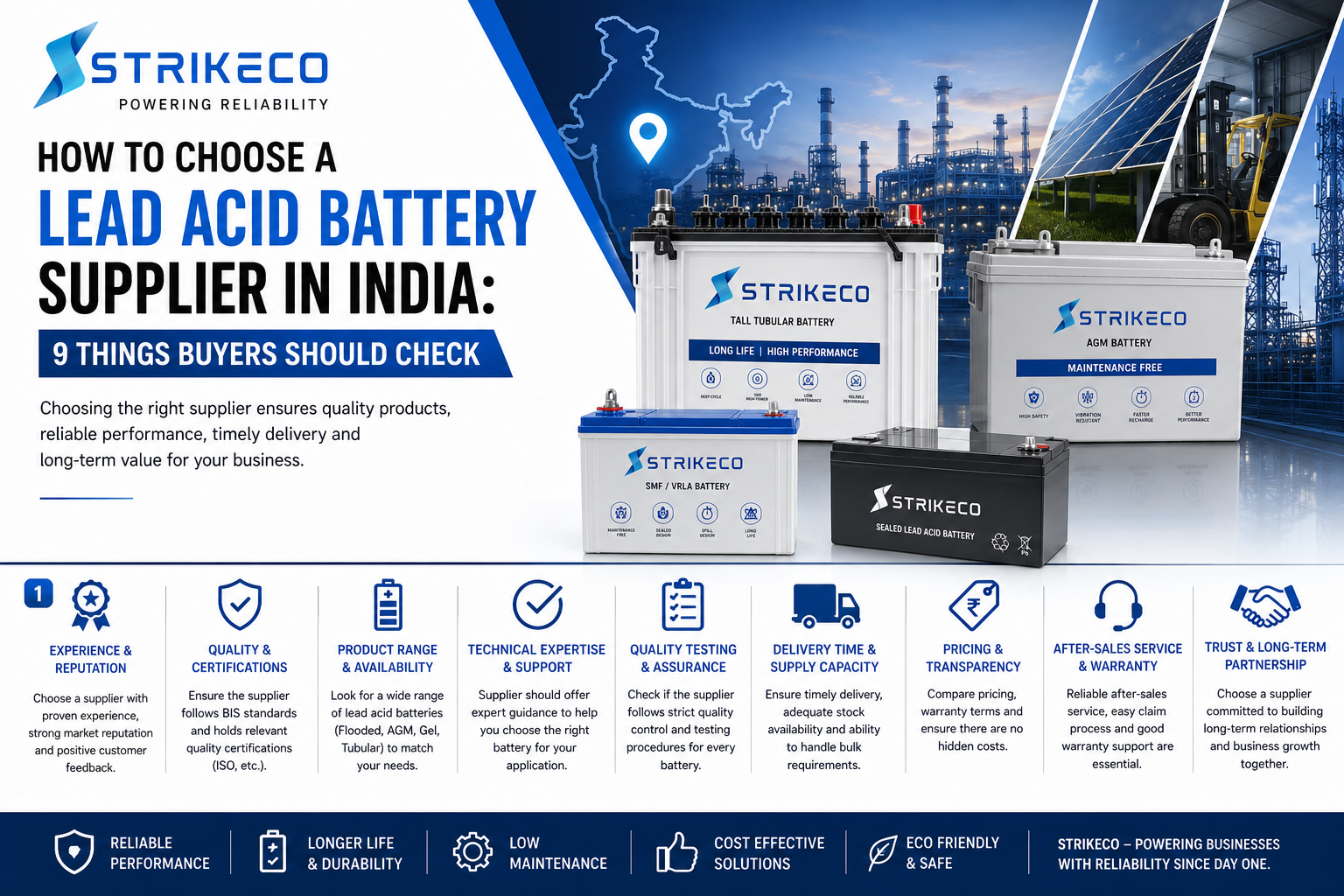
How to Choose a Lead Acid Battery Supplier in India: 9 Things Buyers Should Check
Choosing a reliable lead acid battery supplier in India requires more than comparing battery prices or selecting the highest Ah rating. Buyers should verify the battery’s intended application, voltage and capacity, construction type, discharge performance, cycle-life data, charging requirements, quality documentation, warranty, stock availability, delivery capability, and technical support.
The right supplier should be able to explain why a particular battery is suitable for your application and support that recommendation with a technical datasheet, test information, charging requirements, warranty terms, and clearly defined commercial conditions.
This is particularly important when buying batteries for UPS systems, inverters, industrial equipment, solar backup, telecommunications, mobility equipment, and other applications where incorrect battery selection can reduce runtime or service life.
How Do You Choose a Reliable Lead Acid Battery Supplier in India?
A reliable lead acid battery supplier should provide clearly specified products, authentic technical documentation, suitable battery options for different applications, transparent warranty terms, appropriate charging guidance, dependable stock and delivery information, and accessible after-sales support. Buyers should evaluate technical suitability before comparing the final purchase price.
Before ordering, evaluate these nine areas:
- Application expertise
- Battery specifications and capacity ratings
- Product quality and performance data
- Standards, certifications and test documentation
- Range of flooded, AGM, gel and VRLA options
- Cycle life and charging requirements
- Price and total ownership cost
- Stock, delivery and technical support
- Warranty, after-sales service and supplier credibility
1. Does the Supplier Understand Your Battery Application?
The first question should not be “What is your cheapest battery?” It should be “Which battery is appropriate for my load and operating conditions?” A capable supplier should ask about voltage, load, backup duration, discharge rate, cycling frequency, charging system, installation environment, and maintenance capability.
A 12 V 100 Ah battery selected for a UPS is not automatically suitable for a solar system simply because both applications require the same nominal voltage and capacity.
A UPS may spend most of its time fully charged and discharge only during power failures. A solar battery may be charged and discharged every day.
The supplier should therefore understand whether the battery will be used for:
- UPS or emergency backup
- Inverter systems
- Solar energy storage
- Telecommunications
- Industrial equipment
- Mobility applications
- Starting applications
- Deep-cycle use
Buyers can review available StrikeCo lead acid battery options when comparing products for different applications.
2. What Battery Specifications and Capacity Ratings Should You Verify?
Always verify nominal voltage, Ah capacity, discharge-rate basis, dimensions, terminal configuration, maximum discharge current, charging specifications, operating temperature, and intended duty. An Ah rating alone does not tell you how much usable energy or runtime a battery will provide under your actual load.
Key specifications include:
| Specification | What Buyers Should Check |
|---|---|
| Nominal voltage | Must match the system or battery-bank design |
| Ah capacity | Required runtime and discharge conditions |
| Capacity rating | Whether Ah is specified at C20, C10, C5 or another rate |
| Maximum discharge current | Suitability for high-current loads |
| Dimensions | Physical compatibility |
| Terminal type | Cable and equipment compatibility |
| Charge voltage/current | Charger compatibility |
| Operating temperature | Suitability for installation conditions |
| Battery type | Flooded, AGM, gel or other VRLA |
| Duty | Standby, starting or cyclic application |
The capacity-rating period is especially important.
A lead acid battery may provide different effective capacities at different discharge rates. Battery University notes that lead acid batteries perform better when discharged more slowly and that available capacity can fall at higher discharge rates.
Therefore, two batteries advertised as “100 Ah” may not perform identically under the same high-current load.
3. How Can Buyers Check the Quality and Expected Performance of Lead Acid Batteries?
Battery quality cannot be established by appearance or marketing claims alone. Buyers should review the manufacturer’s technical datasheet, discharge curves, capacity ratings, cycle-life information, charging parameters, operating-temperature limits, construction details, manufacturing date information where available, and warranty conditions.
Useful performance information may include:
- Capacity at different discharge rates
- Discharge-voltage curves
- Expected cycle life under specified conditions
- Recommended depth of discharge
- Float and cyclic charging voltage
- Maximum charging current
- Self-discharge characteristics
- Temperature-related performance
- Design or expected service-life information where supported by test conditions
Be cautious with claims such as “long-life battery” or “high cycle life” unless the conditions are provided.
Cycle life can change significantly with depth of discharge, temperature, charging quality, and operating conditions. Elevated temperatures and repeated deep discharge can accelerate degradation in lead acid batteries.
For example, comparing “1,000 cycles” from one supplier with “800 cycles” from another is meaningless unless both figures were measured at comparable depth of discharge, temperature, charging method, and end-of-life criteria.
4. What Certifications, Standards and Test Reports Should You Ask For?
Buyers should request only documentation relevant to the battery being purchased rather than assuming every certification applies to every battery. Useful documentation can include product datasheets, test reports, quality-management certifications, applicable product standards, regulatory documentation, warranty terms, and manufacturer or importer details.
Depending on product type and application, buyers may ask for:
- Technical datasheet
- Product test report
- Applicable standard references
- Quality-management documentation
- Safety-related documentation where relevant
- Manufacturing or batch information
- Warranty document
- Importer/manufacturer information
- Environmental or recycling-related documentation where required
- Certificate copies for claims made in the quotation
The important principle is verification.
If a supplier states that a battery meets a particular standard, ask which exact standard, which product or model it applies to, and whether supporting documentation is available.
Do not assume that a general company-level certificate proves the electrical performance of every battery model offered by that supplier.
5. Does the Supplier Offer the Right Flooded, AGM, Gel or VRLA Battery?
A good supplier should help buyers choose battery technology according to the application rather than simply selling whichever product is available. Flooded batteries, AGM batteries, and gel batteries have different maintenance, charging, current-delivery, installation, and cycling characteristics.
A simplified comparison is:
| Battery Type | Often Suitable For | Main Consideration |
|---|---|---|
| Flooded | Inverters, solar, industrial and maintained installations | Requires greater maintenance and ventilation |
| AGM | UPS, backup, mobility and high-current applications | Low maintenance and strong current delivery |
| Gel | Selected deep-cycle and standby applications | Requires correct charging profile |
| VRLA | UPS and stationary backup applications | AGM and gel are VRLA technologies |
Flooded Batteries
Flooded batteries contain liquid electrolyte and may require periodic water-level maintenance. They can be cost-effective where proper ventilation and routine servicing are available.
AGM Batteries
AGM uses absorbent glass mats to hold the electrolyte. AGM batteries typically offer low internal resistance and can deliver strong current, making them widely used in UPS, backup, automotive and other applications.
Gel Batteries
Gel batteries immobilize the electrolyte using a gelling material. They can suit certain cycling or standby applications but require an appropriate charging profile.
A supplier should therefore ask about the application, not merely the requested Ah capacity.
6. Why Should Buyers Compare Cycle Life and Charging Requirements?
Cycle life and charging compatibility strongly influence battery ownership cost. A cheaper battery can become expensive if it requires frequent replacement, while incorrect charging can shorten the service life of even a high-quality battery. Always compare cycle-life conditions and verify that the charger matches the battery technology.
Lead acid batteries need appropriate voltage control during charging. Too little charging can contribute to sulfation, while excessive charging voltage can accelerate corrosion and water loss.
Before purchasing, ask the supplier for:
- Recommended bulk-charge voltage
- Float voltage
- Maximum charging current
- Temperature compensation requirements
- Recommended charger type
- Charging time
- Equalization requirements, if applicable
This becomes particularly important when moving from one technology to another.
Do not assume that a charger previously used with a flooded battery will automatically be ideal for AGM or gel.
Buyers looking for a compatible solution can review StrikeCo lead acid battery chargers alongside the battery specification.
7. Why Should You Compare Total Cost Instead of Battery Price Alone?
The lowest battery price does not necessarily provide the lowest ownership cost. Buyers should compare capacity under real discharge conditions, cycle life, expected replacement frequency, maintenance requirements, charging efficiency, warranty, downtime implications, and delivery or service costs alongside the purchase price.
Consider a simplified comparison:
| Battery A | Battery B | |
|---|---|---|
| Purchase price | ₹8,000 | ₹9,500 |
| Warranty | 12 months | 24 months |
| Expected cycling | Lower | Higher |
| Maintenance | Regular | Minimal |
| Replacement frequency | Potentially higher | Potentially lower |
Battery B costs ₹1,500 more initially.
That does not automatically make it better. However, if its documented performance suits the application and results in fewer replacements and less maintenance, it could provide better total value.
The opposite is also possible if the application does not require those additional characteristics.
That is why buyers searching for the best lead acid battery prices in India should compare technically equivalent products rather than simply sorting quotations from lowest to highest.
8. What Should You Check About Stock, Delivery and Technical Support?
A battery supplier should be able to confirm whether the required model and quantity are actually available, provide a realistic dispatch timeline, explain transportation conditions, and offer technical assistance for sizing, installation and charging. Large industrial or multi-battery orders require more supply-chain verification than a single retail purchase.
Before placing the purchase order, confirm:
- Quantity currently available
- Manufacturing or stock age where relevant
- Dispatch timeline
- Delivery location
- Transportation cost
- Packaging method
- Handling of transit damage
- Availability of repeat quantities
- Replacement lead time
- Technical contact for sizing or charging questions
For industrial projects requiring dozens or hundreds of batteries, availability of one sample unit does not prove the supplier can fulfill the complete order on schedule.
Also ask whether the supplier can maintain continuity of the same model when future replacements or system expansion are expected.
9. What Warranty and After-Sales Service Should a Lead Acid Battery Supplier Provide?
Warranty should be evaluated based on coverage and claim procedure, not just duration. Buyers should understand what constitutes a valid claim, what conditions void the warranty, how failed batteries are assessed, whether replacement is full or prorated, and how quickly technical or replacement support is available.
Questions worth asking include:
- When does warranty coverage begin?
- What defects are covered?
- What exclusions apply?
- Does deep discharge affect warranty eligibility?
- Does using an incompatible charger void coverage?
- Is replacement full or prorated?
- Who pays transportation for a warranty claim?
- How long does evaluation take?
- Is on-site support available for industrial customers?
- What proof of purchase or installation documentation is required?
These terms should ideally be available in writing before payment.
What Red Flags Should Buyers Watch for When Buying Lead Acid Batteries Online?
Common warning signs include incomplete specifications, unclear manufacturing origin, no technical datasheet, unrealistic capacity claims, missing warranty terms, unusually low prices without explanation, unclear seller identity, incompatible charger recommendations, old stock, and reluctance to provide test or product documentation.
Be particularly careful when you notice:
- Ah rating without discharge-rate information
- No clear flooded/AGM/gel classification
- Product photos that do not match specifications
- Claims such as “maintenance-free forever”
- Extremely high cycle-life claims without test conditions
- No recommended charging voltage
- Warranty stated only verbally
- Major price differences with no technical explanation
- Seller unable to identify the manufacturer
- No process for damaged or defective deliveries
These checks are useful whether you buy lead acid batteries online in India or purchase directly from a distributor.
Lead Acid Battery Supplier Comparison Checklist
Before finalizing a supplier, use the same criteria for every quotation:
| Evaluation Area | What to Verify |
|---|---|
| Application suitability | Battery designed for required duty |
| Voltage and Ah | Correct system specifications |
| Capacity rating | C-rate/test basis clearly stated |
| Battery technology | Flooded, AGM, gel or VRLA |
| Performance data | Datasheet and discharge curves |
| Cycle life | Test conditions clearly stated |
| Charging | Compatible voltage/current requirements |
| Documentation | Relevant certificates and reports |
| Manufacturing/stock | Product age and availability |
| Warranty | Written coverage and exclusions |
| Delivery | Quantity and dispatch commitment |
| Technical support | Sizing and troubleshooting assistance |
| After-sales service | Replacement and claim process |
| Price | Compared with equivalent specifications |
For a large purchase, procurement teams can score each category from 1 to 5 and compare suppliers using the same framework.
What Documents Should You Request Before Ordering?
For an industrial or commercial battery purchase, request the product datasheet, quotation with model number and quantity, battery type and rating, charging specifications, applicable test or certification documents, warranty terms, delivery schedule, return or replacement conditions, and supplier/manufacturer details.
For larger orders, also confirm batch information, inspection arrangements, and the process for handling damaged or underperforming units.
Buying Lead Acid Batteries Online in India: Final Checks
Lead acid battery online shopping can make price and model comparison easier, but the listing should provide enough technical information to make an informed purchase.
Do not select a product because its title says “12 V 100 Ah battery” and its price is attractive.
Before clicking buy, confirm:
Voltage → Ah and capacity rating → application → battery type → charging specification → dimensions → terminals → operating conditions → warranty → seller → delivery terms.
A trustworthy battery seller should be able to answer technical questions before the transaction, not only process the order afterward.
Choosing a reliable lead acid battery supplier in India starts with technical suitability rather than price.
The most effective purchasing sequence is:
Define your application → calculate the battery requirement → choose the right battery technology → compare datasheets and performance → verify charging compatibility → review documentation → compare total cost → verify delivery → confirm warranty and support.
Lead acid remains widely used because it can provide cost-effective bulk power for applications ranging from vehicles and forklifts to UPS systems. However, its performance and longevity depend heavily on correct charging, discharge conditions and operating temperature.
If you are comparing lead acid battery suppliers in India, use the quotation as only one part of the decision. Product documentation, application knowledge, technical support, warranty and supply reliability can be equally important.
Frequently Asked Questions
How do I know if a lead acid battery supplier is reliable?
Look for complete technical specifications, clear manufacturer information, applicable test and compliance documentation, transparent warranty terms, appropriate battery recommendations, realistic delivery commitments and accessible technical support.
What should I check before buying a lead acid battery online?
Verify voltage, Ah capacity and its rating basis, battery type, intended application, charging requirements, dimensions, terminals, cycle-life information, manufacturing details, warranty, seller credentials and delivery conditions.
Is a higher Ah battery always better?
No. Higher Ah generally provides greater nominal capacity, but it must still match the system voltage, charging equipment, physical space, discharge requirement and application. Capacity also depends on discharge rate and operating conditions.
Should I choose AGM or flooded lead acid?
AGM is useful when low maintenance, vibration resistance and strong current delivery matter. Flooded batteries can be economical where regular maintenance and ventilation are practical. Neither is universally better.
How important is the battery charger?
Very important. Lead acid batteries require controlled charging, and inappropriate charging voltage can accelerate sulfation, corrosion or other degradation. The charger should match the manufacturer’s requirements for the specific battery type.
Why are two batteries with the same Ah rating priced differently?
They may differ in construction, discharge performance, plate design, cycle-life characteristics, warranty, manufacturing quality, battery type, capacity-rating conditions or seller support. Compare the full technical datasheets rather than Ah alone.
Where can I learn more about lead acid battery characteristics?
Battery University provides a useful technical overview of lead acid construction, charging, discharge behavior and common applications. Lead acid battery technical overview – Battery University
