
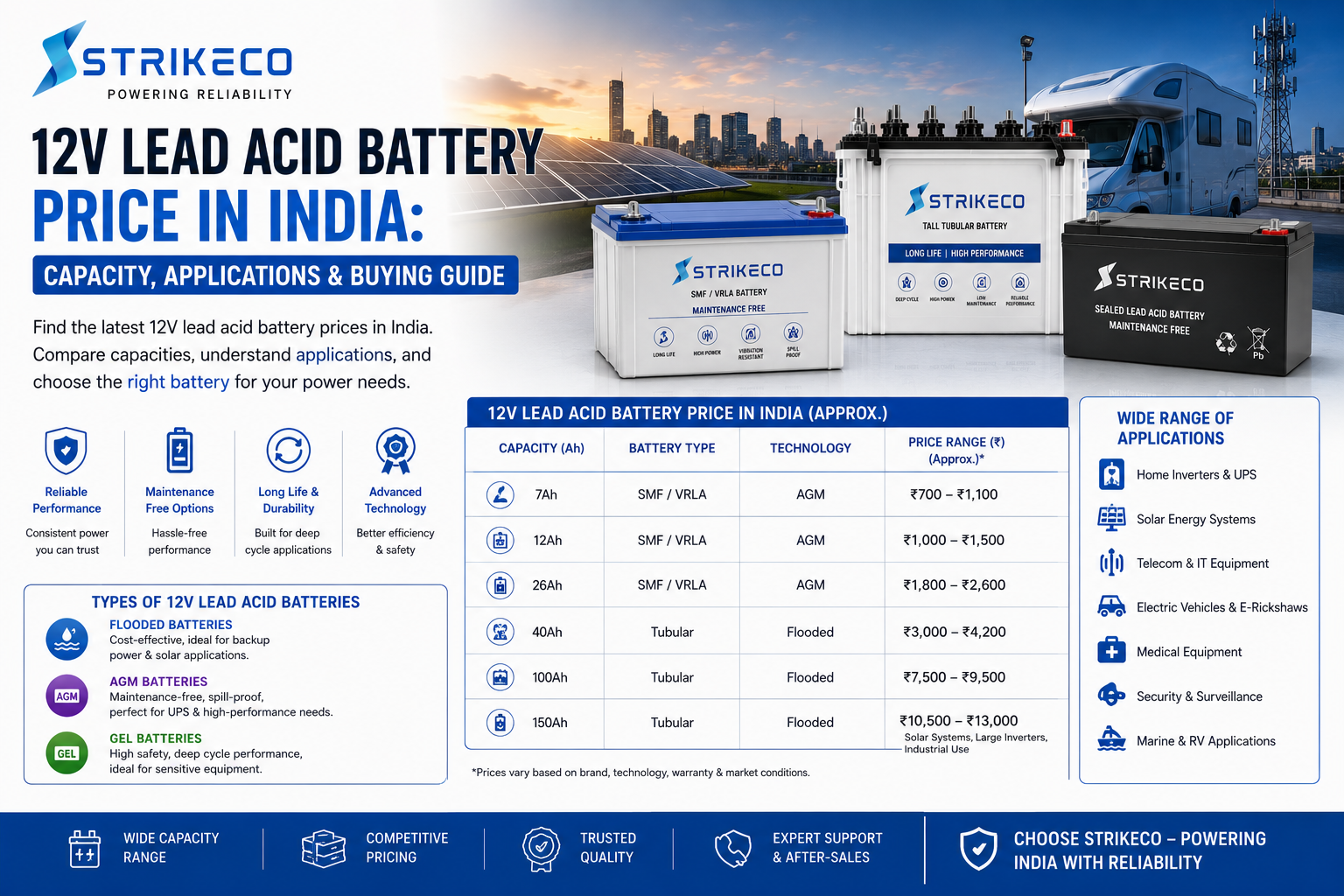
12V Lead Acid Battery Price in India: Capacity, Applications & Buying Guide
The price of a 12V lead acid battery in India varies widely based on Ah capacity, battery type, intended application, brand, warranty, construction, cycle-life characteristics, and seller. Small 7Ah batteries used in UPS and security systems may cost under ₹1,000 to around ₹1,500, while higher-capacity 65Ah or 100Ah batteries can cost several thousand rupees or more.
Current online listings illustrate the variation: 12V 7Ah sealed lead acid batteries are available around ₹930–₹1,300, 12Ah models around ₹1,800–₹2,000, 26Ah models around ₹2,900–₹3,600, a 65Ah SMF-VRLA model around ₹7,200, and one 100Ah SMF listing around ₹9,100. These are examples rather than fixed market prices; pricing can change with brand, technology, warranty, taxes, seller, and availability.
For buyers, therefore, the important question is not simply “What is the cheapest 12V battery?” but “Which 12V battery has the correct capacity and specifications for my application?”
What Is the Price of a 12V Lead Acid Battery in India?
A 12V lead acid battery can cost from under ₹1,000 for a small 7Ah sealed battery to ₹9,000 or more for certain 100Ah models. Higher-capacity inverter, industrial, solar, automotive, or specialized batteries may cost considerably more depending on construction and application.
A useful indicative snapshot from current Indian online listings is:
| Capacity | Example Current Online Price | Typical Application |
|---|---|---|
| 7Ah | ₹930–₹1,300 | UPS, alarm, emergency lighting |
| 12Ah | ₹1,799–₹2,029 | UPS, security, communication backup |
| 20Ah | Varies by brand/type | UPS, equipment, medium backup |
| 26Ah | ₹2,940–₹3,636 | UPS, telecom, medical/security backup |
| 40Ah | Varies by brand/type | Backup and equipment applications |
| 65Ah | Around ₹7,200 for one SMF-VRLA listing | Larger UPS/backup systems |
| 100Ah | Around ₹9,100 for one SMF listing | Larger backup and industrial applications |
The 7Ah, 12Ah, 26Ah and 65Ah examples above come from current Indian marketplace listings, while the 100Ah figure is from an Indian reseller listing.
These figures should not be treated as a permanent lead acid battery price list in India. Battery prices can change frequently, and two batteries with the same voltage and Ah rating may have very different specifications.
Why Do 12V Lead Acid Battery Prices Vary?
12V battery price varies because voltage alone tells you very little about the amount of energy stored or the battery’s construction. Ah capacity, AGM or flooded design, plate construction, cycle-life characteristics, discharge capability, warranty, intended application, manufacturing quality, and brand all influence the final price.
A 12V 7Ah battery and a 12V 100Ah battery both operate at the same nominal voltage, but their energy capacities are dramatically different.
Nominal energy can be estimated using:
Wh = Voltage × Ah
Therefore:
12V × 7Ah = 84Wh
while:
12V × 100Ah = 1,200Wh
The 100Ah battery stores roughly 14 times the nominal energy of the 7Ah battery.
Battery technology also matters. An AGM/VRLA battery can have different construction and maintenance characteristics from a conventional flooded lead acid battery.
Warranty is another factor. For example, current online listings show some 12V 26Ah batteries with warranties ranging from six months to two years, reinforcing why price comparisons should include warranty and specifications rather than Ah alone.
What Ah Capacity Should You Choose for a 12V Lead Acid Battery?
Choose Ah capacity based on the load, required runtime, permissible depth of discharge, discharge rate, system efficiency, and operating conditions. Higher Ah generally means more stored energy, but buying an unnecessarily large battery can increase cost, size, weight, and charging time.
Start with:
Required energy (Wh) = Load (W) × Runtime (hours)
Then:
Basic Ah = Required Wh ÷ 12V
Suppose you need to run a 120W load for two hours:
120 × 2 = 240Wh
The theoretical Ah requirement is:
240 ÷ 12 = 20Ah
But a 20Ah battery should not automatically be selected.
You may need extra capacity for:
- allowable depth of discharge;
- inverter losses;
- higher discharge rates;
- battery aging;
- temperature;
- desired safety margin.
If the system uses only 50% of nominal battery capacity as the design target, the theoretical requirement already becomes:
20Ah ÷ 0.50 = 40Ah
The manufacturer’s discharge data should then be checked before finalizing the battery.
Buyers can compare available 12V lead acid battery options after calculating their actual requirements.
How Do 7Ah, 12Ah, 20Ah, 26Ah, 40Ah, 65Ah and 100Ah Batteries Differ?
The main difference is available charge and nominal stored energy. Small-capacity batteries are commonly used in alarms, emergency lighting and compact UPS systems, while higher-capacity batteries can support larger loads or longer backup periods. Application suitability also depends on discharge capability and battery design.
12V 7Ah Batteries
A 7Ah battery provides approximately:
12 × 7 = 84Wh nominal energy
Common applications include:
- Small UPS systems
- Alarm systems
- Emergency lighting
- Security equipment
- Access-control systems
- Small electronic devices
Current Indian listings show 7Ah AGM/VRLA models around ₹930–₹1,300, although pricing varies.
12V 12Ah Batteries
Nominal energy:
12 × 12 = 144Wh
These can suit somewhat longer-duration or higher-load applications such as UPS, communication systems, emergency lighting and security equipment.
Current examples are listed around ₹1,799–₹2,029.
12V 20Ah and 26Ah Batteries
A 20Ah battery has approximately 240Wh nominal energy, while 26Ah provides approximately 312Wh.
These sizes are often considered for medium backup loads, UPS systems, telecom equipment, medical equipment, surveillance systems and industrial electronics.
A current 26Ah SMF-VRLA listing is around ₹2,940, while other 26Ah options are around ₹3,100–₹3,600.
12V 40Ah and 65Ah Batteries
Their nominal energy is approximately:
40Ah = 480Wh
65Ah = 780Wh
These larger batteries can support higher loads or longer backup durations when correctly sized.
A current 65Ah SMF-VRLA product listing is approximately ₹7,201.
12V 100Ah and Higher Batteries
A 12V 100Ah battery provides approximately:
1,200Wh nominal energy
Such capacities can be considered for larger UPS, backup, inverter, telecom and industrial systems depending on the battery’s intended duty.
One current Indian reseller listing shows a 12V 100Ah SMF battery at approximately ₹9,100, demonstrating how price rises substantially with capacity.
Which 12V Lead Acid Battery Is Best for UPS, Inverter, Solar and Backup Power?
There is no single best 12V battery for every application. UPS and security applications commonly use AGM/VRLA batteries, while inverter and solar applications may require batteries designed for repeated deep cycling. Industrial applications should be selected according to load characteristics, discharge requirements, reliability needs, temperature and charging system.
For UPS systems, AGM or VRLA batteries are commonly considered because of their low-maintenance design and suitability for standby applications.
For home inverters, flooded tubular or suitable deep-cycle lead acid batteries may be appropriate where regular cycling and longer backup are required.
For solar applications, battery selection should prioritize cycle capability, permissible depth of discharge and charging compatibility rather than simply choosing the highest Ah.
For security and alarm systems, compact 7Ah or 12Ah VRLA batteries are common because the power requirement is relatively small.
For industrial backup, capacity may range from smaller individual batteries to large multi-battery banks depending on critical load and backup duration.
How Do You Calculate 12V Lead Acid Battery Runtime?
A simplified runtime estimate is calculated by multiplying 12V by the battery’s Ah capacity, applying usable depth of discharge and system efficiency, and dividing by the load in watts. Real runtime can be lower because lead acid batteries deliver less effective capacity at higher discharge rates.
A simplified formula is:
Runtime = (12 × Ah × usable DoD × efficiency) ÷ load
Consider a 12V 100Ah battery supplying a 200W AC load through an inverter.
Nominal energy:
12 × 100 = 1,200Wh
Assume 50% usable depth of discharge:
1,200 × 0.50 = 600Wh
Assume inverter efficiency of 90%:
600 × 0.90 = 540Wh
Estimated runtime:
540 ÷ 200 = 2.7 hours
So the simplified estimate is approximately 2 hours 42 minutes.
Actual runtime may differ.
Battery University explains that higher C-rates generally produce lower measured capacity because faster discharge creates greater internal losses. Lead acid batteries are therefore often rated at relatively slow discharge rates such as C20.
Why Does a 100Ah Battery Sometimes Provide Less Runtime Than Expected?
The common assumption is:
12V × 100Ah = 1,200Wh, therefore a 100W load should run for 12 hours.
Real systems rarely behave this way.
Several factors reduce usable runtime:
- Battery should not necessarily be discharged to 100% DoD.
- Inverters consume energy.
- Available capacity declines at higher discharge rates.
- Battery voltage falls during discharge.
- Older batteries generally have reduced capacity.
- Low temperatures can reduce available performance.
- Poor charging may leave the battery below full state of charge.
For accurate sizing, use the battery manufacturer’s constant-current or constant-power discharge tables rather than depending solely on Ah arithmetic.
What Should You Compare Besides Price?
Battery price should be compared only after confirming technical suitability. Two 12V 100Ah batteries may have different capacity-rating conditions, cycle-life performance, charging requirements, construction, discharge capability, warranty, dimensions and intended applications.
Compare these specifications:
| Factor | Why It Matters |
|---|---|
| Voltage | Must match equipment |
| Ah rating | Influences capacity |
| Capacity test rate | Shows how Ah was measured |
| Battery type | Flooded, AGM, gel or other VRLA |
| Application | Standby, starting or cycling |
| Discharge curves | Helps predict actual runtime |
| Maximum current | Important for heavy loads |
| Cycle life | Relevant for repeated use |
| Charging voltage | Must match charger |
| Operating temperature | Affects real performance |
| Size and terminals | Must physically fit |
| Warranty | Influences purchase protection |
| Manufacturing date | Important when evaluating stored inventory |
| Seller support | Useful for warranty and replacements |
This is why searches for the best lead acid battery prices in India should be followed by a technical comparison rather than simply buying the cheapest listing.
Does the Charger Matter When Buying a 12V Lead Acid Battery?
Yes. The charger must match the battery’s voltage, chemistry, capacity and recommended charging profile. Flooded, AGM and gel batteries can have different charging requirements, and incorrect charging can reduce performance or shorten battery life.
For a 12V battery, do not simply buy any charger advertised as “12V.”
Check:
- Supported lead acid battery type
- Recommended charging voltage
- Maximum charging current
- Float-charging capability
- Battery Ah range
- Temperature compensation if required
If you need a compatible charging solution, StrikeCo also lists lead acid battery chargers.
For additional technical background on battery discharge rates, Battery University provides a detailed explanation of C-rates and how faster discharge can reduce measured lead acid capacity.
What Should You Check Before Buying a 12V Lead Acid Battery Online in India?
Before you buy a lead acid battery online in India, verify that the listing gives enough information to confirm compatibility.
Check:
- Exact battery model
- 12V nominal voltage
- Required Ah capacity
- Capacity-rating basis such as C20 or C10
- AGM, gel, flooded or VRLA construction
- Standby or cyclic application
- Recommended charging voltage/current
- Dimensions
- Weight
- Terminal size and orientation
- Operating-temperature range
- Warranty duration and exclusions
- Manufacturing or stock-date information where available
- Return/replacement policy
- Seller or supplier identity
Also verify availability before placing a critical order. Some current Indian listings show batteries as “available on request,” meaning a visible product page does not necessarily guarantee immediate inventory.
For businesses carrying out lead acid battery online shopping or purchasing multiple units, checking stock age, consistent batch supply and replacement availability can be particularly important.
12V Lead Acid Battery Buying Checklist
Before finalizing your purchase, make sure:
- The electrical load is known.
- Required runtime has been calculated.
- 12V is the correct system voltage.
- Ah capacity has been properly calculated.
- Discharge-rate effects have been considered.
- Battery type matches the application.
- Cycle-life requirements are understood.
- Correct charger is available.
- Dimensions and terminals fit the equipment.
- Manufacturer discharge data is available.
- Warranty terms are clear.
- Product price is compared with equivalent specifications.
- Supplier stock and delivery are confirmed.
Final Thoughts
The 12V lead acid battery price in India can vary from around ₹1,000 for compact UPS batteries to several thousand rupees for higher-capacity batteries, with 65Ah and 100Ah models potentially reaching ₹7,000–₹9,000 or more depending on technology, brand and application. Current marketplace examples demonstrate these price differences, but they should be treated as snapshots rather than permanent prices.
A better buying sequence is:
Determine load → calculate runtime → calculate Ah → choose battery type → check discharge performance → verify charging requirements → compare warranty → compare price.
For buyers looking to buy lead acid batteries online in India, starting with the technical requirement prevents the common mistake of choosing a battery simply because it has the lowest price or highest Ah number.
Suitable capacities can then be compared on the StrikeCo lead acid battery range.
Frequently Asked Questions
What is the price of a 12V 7Ah battery in India?
Current online examples range from about ₹930 to ₹1,300 for certain branded 7Ah AGM/VRLA batteries, although actual prices depend on brand, seller, warranty and availability.
What is the price of a 12V 26Ah lead acid battery?
Current Indian marketplace examples for 26Ah SMF/VRLA batteries range from approximately ₹2,940 to ₹3,636. Prices can change and should be verified at purchase time.
How long will a 12V 100Ah battery run a 100W load?
The battery has approximately 1,200Wh of nominal energy, but actual runtime will be below the simple theoretical 12-hour figure once depth of discharge, inverter efficiency, discharge rate, temperature and battery condition are considered.
Is a 100Ah battery better than a 65Ah battery?
Not automatically. A 100Ah battery offers more nominal capacity, but the correct choice depends on required runtime, load, charging system, available space, battery type and budget.
Which 12V battery is best for a UPS?
AGM/VRLA batteries are commonly used for UPS applications because they are low maintenance and designed for standby use. Capacity should be chosen according to UPS voltage, power requirement, discharge rate and required backup time.
Can I replace a 12V 7Ah battery with a 12V 12Ah battery?
Potentially, but voltage alone is not enough. Check whether the equipment and charger support the higher Ah capacity and whether the larger battery physically fits. Terminal layout and charging time should also be considered.
Why are two 12V 100Ah batteries priced differently?
Differences may include battery construction, capacity test rate, plate design, cyclic or standby duty, discharge capability, manufacturing quality, warranty, charging characteristics, dimensions and brand.
