
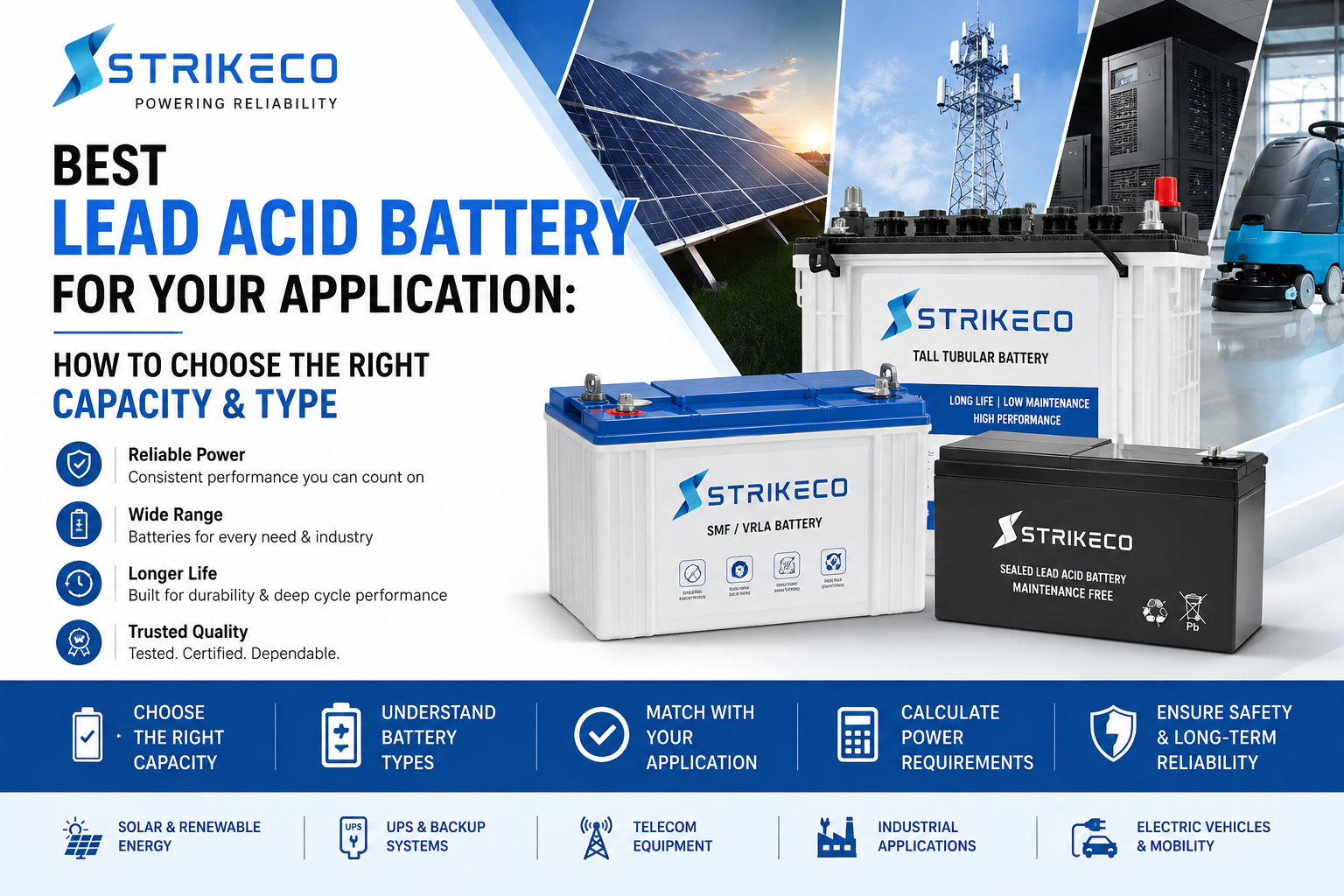
Best Lead Acid Battery for Your Application: How to Choose the Right Capacity & Type
Choosing the best lead acid battery depends on the application, required backup time, load, battery voltage, expected depth of discharge, charging system, maintenance preference, operating temperature, and required cycle life.
There is no single lead acid battery type that is best for every use. A flooded battery may suit cost-sensitive applications where maintenance is acceptable, AGM may be better where high current delivery and low maintenance are important, while gel batteries can suit selected deep-cycle and higher-temperature applications. AGM and gel are both forms of valve-regulated lead acid, or VRLA, batteries.
For buyers planning to buy lead acid batteries online in India, the right approach is to first calculate the electrical requirement, then choose the battery chemistry and construction, and only after that compare brands, prices, warranty, and charger compatibility.
What Type of Lead Acid Battery Is Best for Different Applications?
The best lead acid battery depends on the duty cycle. Flooded batteries can suit applications where regular maintenance is possible, AGM batteries work well where high current, vibration resistance, and low maintenance are priorities, while gel batteries can suit applications requiring deeper cycling or operation in warmer environments.
A practical starting point is:
| Application | Lead Acid Type Often Considered | Main Reason |
|---|---|---|
| UPS / emergency backup | AGM or VRLA | Low maintenance and standby suitability |
| Home inverter | Flooded tubular or suitable deep-cycle lead acid | Cost and deep-cycle capability |
| Solar backup | Deep-cycle flooded, AGM or gel | Repeated charge/discharge cycles |
| Industrial standby power | VRLA / AGM / suitable flooded designs | Reliability and backup capability |
| Mobility equipment | AGM or gel | Spill resistance and cycling |
| High-current applications | AGM | Low internal resistance and high current delivery |
| Hot environments / selected deep-cycle uses | Gel | Good cycling and heat tolerance |
| Cost-sensitive maintained installations | Flooded | Lower initial cost and serviceability |
Battery University notes that AGM has low internal resistance and can deliver high current, while gel designs tend to tolerate warmer environments and can offer strong cycling characteristics.
The application should therefore determine the battery—not the other way around.
What Are the Different Types of Lead Acid Batteries?
Lead acid batteries can be grouped mainly into flooded and valve-regulated lead acid (VRLA) designs. AGM and gel batteries are both VRLA technologies, but they manage the electrolyte differently.
Flooded Lead Acid Batteries
A flooded battery contains liquid electrolyte surrounding the lead plates.
These batteries may be suitable when:
- Routine maintenance is possible
- Adequate ventilation is available
- Initial cost is important
- The application requires a conventional deep-cycle or standby solution
Depending on construction, flooded batteries can require checking electrolyte levels and adding distilled water.
They should normally be installed upright and in a properly ventilated location.
AGM Batteries
AGM stands for Absorbent Glass Mat. The electrolyte is absorbed into a fiberglass separator rather than remaining as freely moving liquid.
AGM batteries can be attractive when buyers need:
- Minimal routine watering
- Spill-resistant construction
- High current output
- Lower internal resistance
- Good vibration resistance
- Compact UPS or backup applications
Battery University notes that AGM technology is widely used in UPS, vehicle, marine, robotic, stationary, and deep-cycle applications.
Gel Batteries
Gel batteries mix the electrolyte with a gelling agent, producing a semi-solid electrolyte.
They can be considered when:
- Repeated cycling is expected
- High-current discharge is not the dominant requirement
- Maintenance should be minimal
- Operating temperatures are relatively demanding
- The charger can provide the correct gel charging profile
Gel batteries are particularly sensitive to incorrect charging voltage, so charger compatibility should be verified before purchase.
What Does VRLA Mean?
VRLA means Valve-Regulated Lead Acid.
AGM and gel batteries fall within the VRLA category. Their construction promotes gas recombination and reduces routine water loss, although they still contain pressure-relief valves and should not be treated as completely sealed systems.
Buyers comparing these technologies can review available lead acid battery options alongside the electrical and environmental requirements of their application.
How Do You Calculate the Right Lead Acid Battery Capacity in Ah?
Battery capacity should be calculated from the load, system voltage, required backup duration, allowable depth of discharge, battery efficiency, and applicable design margin. Ah alone cannot be selected correctly without knowing how much power the load requires and for how long.
A simplified calculation starts with:
Required energy in Wh = Load in watts × Backup time in hours
Then:
Basic battery capacity in Ah = Required Wh ÷ Battery-system voltage
After that, adjustments should be made for allowable depth of discharge, conversion losses, aging, discharge rate, temperature, and design margin.
Practical Example
Suppose a backup system needs to operate a 300 W load for 4 hours using a 12 V battery bank.
Required energy:
300 W × 4 hours = 1,200 Wh
Ideal battery capacity:
1,200 Wh ÷ 12 V = 100 Ah
However, a 100 Ah battery is unlikely to be the correct real-world selection if the design intends to avoid fully discharging the battery.
If the design permits only 50% usable depth of discharge:
100 Ah ÷ 0.50 = 200 Ah
Additional allowance may then be needed for inverter losses, battery aging, temperature, and the effect of discharge rate.
So the actual design could require a battery bank larger than 200 Ah.
This is why battery sizing should not be performed by simply matching a wattage figure to an Ah number.
What Is the Difference Between Voltage, Ah, C-Rate and Wh?
These four terms describe different battery characteristics.
| Term | Meaning | Example |
|---|---|---|
| Voltage (V) | Electrical potential | 12 V battery |
| Amp-hour (Ah) | Charge capacity | 100 Ah |
| Watt-hour (Wh) | Approximate energy capacity | 12 V × 100 Ah = 1,200 Wh |
| C-rate | Charge/discharge rate relative to capacity | 0.1C on 100 Ah = 10 A |
Battery Voltage
Voltage must match the electrical system.
A 24 V system may use two compatible 12 V batteries connected in series, while larger systems may use 48 V or other configured battery banks.
Ah Capacity
Amp-hours indicate how much electrical charge the battery can theoretically deliver under specified test conditions.
A higher Ah rating generally means greater storage capacity, but actual usable capacity depends on discharge rate, temperature, age, and depth of discharge.
Energy Capacity in Wh
For a simplified nominal calculation:
Wh = Voltage × Ah
Therefore:
12 V × 100 Ah = approximately 1,200 Wh nominal energy
That does not mean all 1,200 Wh should necessarily be used during each discharge.
C-Rate
C-rate expresses current relative to battery capacity.
For a 100 Ah battery:
- 0.1C = 10 A
- 0.2C = 20 A
- 0.5C = 50 A
Lead acid battery capacity can vary depending on how quickly energy is withdrawn, so the manufacturer’s stated discharge-rate data should be considered when accurate sizing is required.
How Do Load, Backup Time and Depth of Discharge Affect Battery Sizing?
Higher loads and longer backup times require more battery capacity. Limiting depth of discharge generally requires a larger battery bank but can reduce stress on lead acid batteries. Temperature, discharge current, battery age, inverter efficiency, and future capacity degradation should also be included in the design.
The most important variables are:
Load: A 1,000 W system requires far more stored energy than a 100 W system.
Backup time: Doubling required runtime approximately doubles the basic energy requirement.
Depth of discharge: Designing around partial rather than complete discharge increases required nominal capacity.
Discharge rate: Lead acid batteries may deliver less effective capacity when discharged at higher rates.
Temperature: Extreme temperatures can affect performance and service life.
Aging: Battery capacity gradually falls with use and time.
Therefore, a battery sized only for perfect new-battery conditions may eventually provide insufficient runtime.
Which Lead Acid Battery Is Best for UPS Systems?
AGM and other VRLA batteries are widely used for UPS applications because they provide low-maintenance standby power in compact installations. The correct battery should still be selected according to UPS voltage, load, required backup time, discharge characteristics, available space, and charging profile.
Battery University identifies UPS as a common application for both AGM and gel lead acid technologies.
For a UPS, check:
- Required battery-bank voltage
- Backup time
- Maximum discharge current
- Space
- Battery replacement interval assumptions
- UPS charging voltage
- Battery temperature
Which Lead Acid Battery Is Best for Inverters?
For inverter applications, deep-cycle capability is usually more important than short-duration starting current.
Flooded tubular or appropriately designed deep-cycle lead acid batteries can therefore be considered where repeated power cuts result in frequent charging and discharging.
Maintenance requirements should also influence the decision.
If regular water checking is impractical, an appropriate maintenance-reduced or VRLA solution may be preferable, subject to charger compatibility.
Which Lead Acid Battery Is Suitable for Solar Applications?
Solar batteries should be selected for repeated cycling rather than only standby service. The battery bank must be sized according to daily energy use, required autonomy, charging availability, allowable depth of discharge, solar-generation profile, and environmental conditions.
Deep-cycle flooded, AGM, and gel batteries can all potentially serve solar applications, but their charging requirements and economic characteristics differ.
Solar sizing should also account for days when solar generation is low rather than assuming the battery will be fully recharged every day.
Which Battery Is Suitable for Industrial and Backup Power?
Industrial standby systems may require:
- High reliability
- Multiple batteries connected into larger banks
- Predictable float charging
- High discharge currents
- Long periods at full charge
- Periodic backup operation
VRLA technology is widely used for stationary backup applications such as UPS and communications systems.
The correct solution should be based on the actual discharge duty and project specifications.
What Factors Should You Compare When Choosing a Lead Acid Battery?
Do not compare batteries using Ah and price alone.
| Factor | Why It Matters |
|---|---|
| Battery type | Determines maintenance and operating characteristics |
| Voltage | Must match the system |
| Ah capacity | Influences available runtime |
| Discharge rating | Shows performance at different loads |
| Cycle life | Important for frequently cycled applications |
| Depth of discharge | Influences usable capacity and cycling |
| Charging requirements | Must match the charger |
| Maintenance | Flooded and VRLA requirements differ |
| Temperature range | Influences performance and aging |
| Dimensions | Battery must fit installation space |
| Terminal configuration | Must suit cables and installation |
| Warranty | Important for purchase protection |
| Manufacturer data | Needed for accurate sizing |
In addition, confirm that the charger is appropriate for the specific battery technology.
AGM, gel, and flooded batteries can require different charging-voltage settings, and Battery University specifically cautions that AGM and gel should not simply be treated as direct charging replacements for flooded batteries.
For a lead acid installation, buyers can therefore also evaluate a compatible lead acid battery charger rather than selecting the battery and charger independently.
Why Cycle Life and Depth of Discharge Matter
Cycle life describes how many charge-discharge cycles a battery can provide under specified test conditions. It is not a fixed lifespan because actual performance depends on discharge depth, temperature, charging, storage conditions, discharge current, and maintenance.
A battery repeatedly discharged deeply may age differently from the same battery used primarily for shallow standby cycles.
This is why advertised cycle-life numbers should always be read together with the manufacturer’s test conditions.
What Should You Check Before Buying a Lead Acid Battery Online in India?
When you buy lead acid batteries online in India, verify the technical specification before comparing offers.
Check:
- Battery voltage
- Rated Ah capacity
- Capacity test rate
- Battery technology: flooded, AGM, gel, or other VRLA
- Intended use: standby, cyclic, starting, solar, UPS, etc.
- Dimensions and weight
- Terminal configuration
- Recommended charge voltage/current
- Operating-temperature specification
- Warranty
- Manufacturing/date information where provided
- Seller and supplier credentials
- Shipping and return terms
- Availability of compatible charger
- Technical datasheet
Be particularly careful when two apparently similar batteries have significantly different prices.
A lower price may reflect differences in construction, rated capacity conditions, warranty, expected cycling capability, manufacturing quality, or seller support.
Consumers searching for the best lead acid battery prices in India should therefore compare like-for-like products rather than treating every 12 V 100 Ah battery as equivalent.
Lead Acid Battery Selection Checklist
Before ordering, confirm:
- ☐ Application is clearly defined
- ☐ Load in watts or amps is known
- ☐ Required backup time is known
- ☐ System voltage is confirmed
- ☐ Battery-bank Ah requirement has been calculated
- ☐ Depth-of-discharge assumption is appropriate
- ☐ Discharge rate has been considered
- ☐ Flooded, AGM, gel, or VRLA type has been selected
- ☐ Cycle requirements are understood
- ☐ Charger compatibility is verified
- ☐ Installation ventilation is suitable
- ☐ Operating temperature is considered
- ☐ Dimensions and terminals fit the installation
- ☐ Manufacturer datasheet has been reviewed
- ☐ Warranty terms are clear
- ☐ Price is being compared against equivalent specifications
The best lead acid battery for your application is not automatically the battery with the highest Ah rating, lowest price, or most advanced label.
Choose in this order:
Define the application → calculate load and runtime → determine system voltage → calculate required Ah → account for depth of discharge and losses → select the battery type → verify charging requirements → compare specifications, warranty, and price.
Flooded, AGM, gel, and other VRLA batteries each have advantages and limitations. Matching those characteristics to the actual duty cycle is far more important than choosing based solely on price.
For buyers comparing a lead acid battery supplier in India or planning lead acid battery online shopping, start with the technical requirement and then review suitable lead acid battery products.
Frequently Asked Questions
How many Ah of battery do I need for a 500 W load?
Start by multiplying 500 W by the required backup time to calculate energy in Wh. Divide that number by the battery-bank voltage, then adjust for depth of discharge, conversion losses, discharge rate, temperature, and design margin.
Is AGM better than a normal lead acid battery?
AGM is not universally better. It offers low maintenance, spill-resistant construction, low internal resistance, and strong current delivery, while conventional flooded batteries can be more economical for applications where maintenance is acceptable.
Is gel or AGM better for deep-cycle use?
Both can support cycling, but their characteristics differ. Gel can perform well in warmer conditions and repeated cycling, whereas AGM generally provides stronger high-current performance and lower internal resistance. Charger compatibility is essential for both.
Can I replace a flooded battery with an AGM battery using the same charger?
Not automatically. Charging-voltage requirements can differ between flooded, AGM, and gel batteries. Check both the battery manufacturer’s charging specification and the charger’s supported battery profiles before replacement.
How do I calculate Wh from Ah?
Multiply nominal battery voltage by Ah capacity. For example, a 12 V 150 Ah battery has approximately 1,800 Wh of nominal energy. Usable energy will generally be lower depending on allowable discharge depth and system losses.
Which lead acid battery is best for long backup?
The right battery depends on the required runtime and cycling pattern. Deep-cycle batteries are generally more appropriate for extended discharge than batteries primarily designed to provide short bursts of starting current.
