
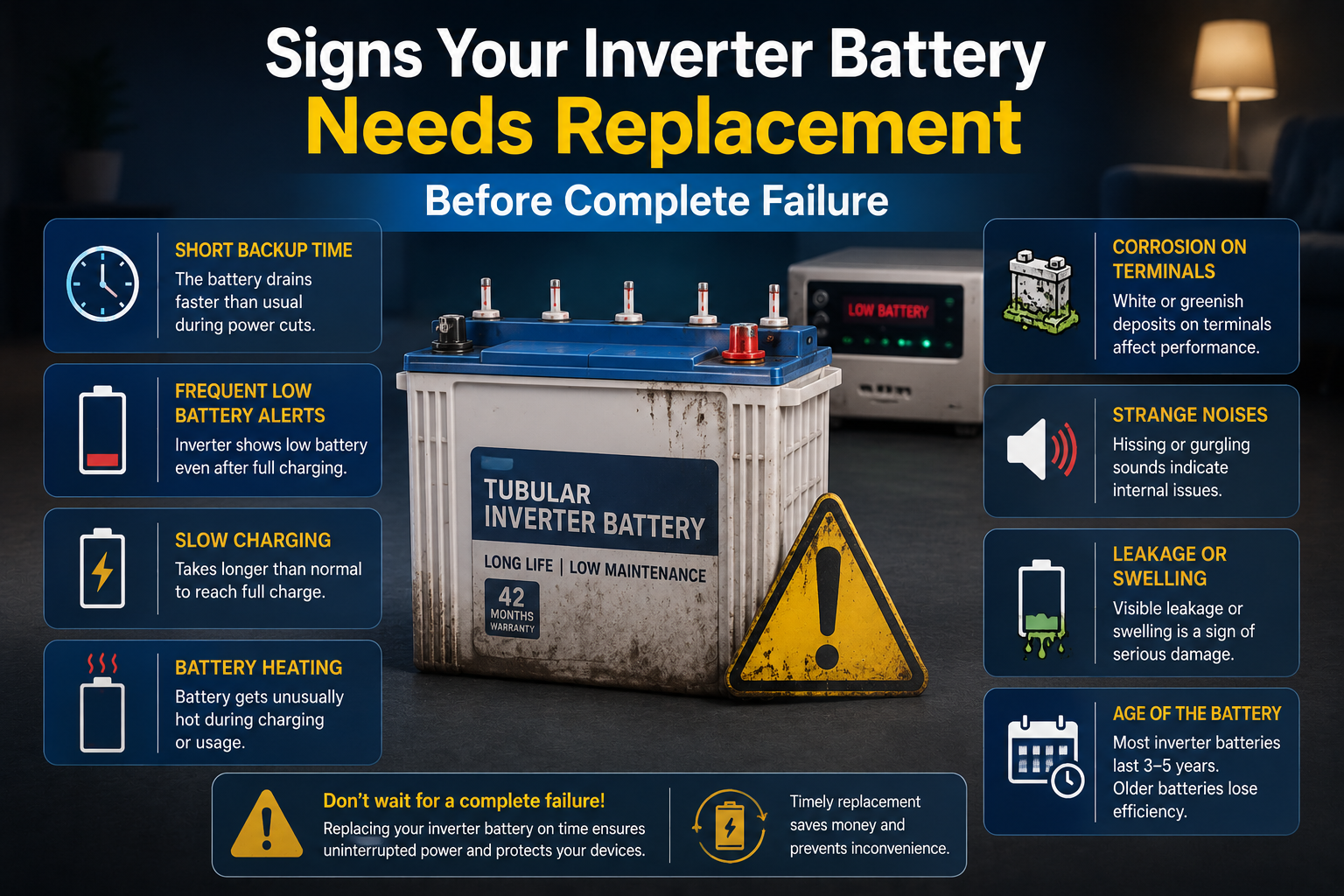
Signs Your Inverter Battery Needs Replacement Before Complete Failure
In inverter battery rarely fails without warning. In most cases, it shows clear signs of weakness long before it stops working completely. Recognizing those signs early can help you avoid sudden power backup failure, protect your appliances, and replace the battery at the right time instead of after an emergency.
If your inverter battery is taking longer to charge, draining faster than usual, or struggling to support your home during outages, it may be nearing the end of its life. Understanding these warning signs can save you money and help you avoid unexpected downtime.
Why inverter battery health matters
Your inverter battery is the heart of your backup power system. It stores energy and releases it when the main power goes out. When the battery starts losing capacity, your inverter may still switch on, but backup time becomes shorter and performance becomes unreliable.
Many people wait until the battery stops working entirely, but by then replacement becomes urgent and inconvenient. Spotting early symptoms gives you time to plan the replacement, compare options, and avoid getting caught without backup during a power cut.
1. Backup time has become noticeably shorter
One of the most common signs of battery failure is reduced backup duration. If your inverter used to support your home for several hours and now lasts only a fraction of that time, the battery may be losing its ability to hold charge.
This usually happens as the internal plates wear out or the battery capacity declines with age. Even if the inverter itself is fine, a weak battery cannot deliver power for long. Shorter backup time is often one of the first and most reliable warning signs.
2. The battery takes longer to charge
A healthy inverter battery should charge within a reasonable time based on its size and usage. If it suddenly takes much longer to reach full charge, that usually means the battery is not accepting charge properly.
Slow charging can be caused by battery aging, internal damage, low electrolyte levels in some battery types, or charging system issues. If this problem keeps happening even after checking the inverter settings, the battery may need replacement soon.
3. Frequent low-battery alerts
If your inverter keeps giving low-battery warnings more often than before, that is a sign the battery is struggling to retain power. These alerts should not be ignored, especially if they happen even after normal charging cycles.
Frequent warnings may mean the battery cannot store enough energy or is dropping voltage too quickly under load. This usually indicates declining health and is a strong reason to inspect the battery closely.
4. The battery is older than usual service life
Every inverter battery has a service life, and once it crosses that age range, performance starts to decline naturally. Lead-acid batteries often last a few years depending on usage, maintenance, temperature, and charging habits.
Even if the battery appears to be working, age alone can be a warning sign. If your battery is nearing the end of its expected lifespan and backup performance has already dropped, replacement is usually the safest choice.
5. Swelling or bulging of the battery body
A swollen or bulging battery case is a serious warning sign. It often means internal pressure has built up due to overheating, overcharging, gas formation, or internal damage.
A swollen battery should not be ignored or used for long. In many cases, it is no longer safe and should be checked immediately by a professional. Physical deformation usually means the battery has already suffered major damage.
6. Leakage or corrosion around terminals
If you notice acid leakage, moisture, or white or green corrosion around the battery terminals, the battery may be damaged. Leaks can affect performance and also create safety issues if not addressed quickly.
Corrosion can interfere with proper charging and power delivery. While terminal cleaning may help in some cases, repeated leakage or heavy corrosion is often a sign that battery replacement is the better option.
7. Strange smell or overheating
A battery that emits a strong smell, especially a sharp chemical odor, may be overheating or internally damaged. Excess heat during charging or discharging is another sign that something is wrong.
Overheating can reduce battery life, lower efficiency, and create safety risks. If the battery feels unusually hot or gives off an odor, stop using it and have it inspected as soon as possible.
8. Backup power becomes inconsistent
Sometimes the battery does not fail completely but behaves unpredictably. It may support appliances one day and struggle the next, even when the charging cycle seems normal.
This inconsistency often means the battery’s internal capacity is no longer stable. If your backup power is becoming unreliable, replacement should be considered before complete failure occurs.
9. The inverter keeps switching off early
If the inverter shuts down too soon during a power cut, the battery may not be delivering enough voltage under load. This can happen even when the battery appears charged.
Early shutdowns usually mean the battery is weak and cannot sustain power demand. This is one of the clearest signs that your backup system is no longer performing properly.
10. More frequent topping up or maintenance
If you have to maintain the battery more often than before, such as checking water levels repeatedly in a lead-acid battery or noticing faster performance drops, the battery may be approaching failure.
A healthy battery should not require excessive attention. Increased maintenance usually means the battery is aging and losing efficiency.
How to tell whether the problem is the battery or the inverter
Not every backup issue is caused by the battery. Sometimes the inverter itself, wiring, or charging circuit may be the problem. That is why it is important to check a few things before deciding on replacement.
Look for signs such as:
- Reduced backup even after full charging.
- Physical damage or swelling.
- Frequent low-voltage alerts.
- Slow charging despite normal input power.
- Age and usage history of the battery.
If multiple signs are present, the battery is usually the main issue.
When replacement is the better choice
You do not need to wait for complete failure before replacing an inverter battery. In fact, replacing it at the right time is often more cost-effective than dealing with repeated power interruptions and poor backup performance.
Consider replacement if:
- The battery is old and backup time has clearly dropped.
- The battery shows swelling or leakage.
- The inverter keeps failing during outages.
- Charging performance has become poor.
- A technician confirms the battery is beyond repair.
Replacing the battery early helps you avoid unexpected breakdowns and keeps your home or business protected during outages.
How to extend battery life
While every battery eventually needs replacement, good care can help extend its life. Proper charging, regular maintenance, and avoiding overload can make a real difference.
To improve battery life:
- Keep the battery in a well-ventilated area.
- Avoid deep discharge whenever possible.
- Check electrolyte levels if your battery type requires it.
- Clean terminals regularly.
- Use a compatible inverter and charger.
- Do not overload the backup system.
These habits can help you get the most from your battery before replacement becomes necessary.
An inverter battery usually gives several warning signs before complete failure. Short backup time, slow charging, swelling, leakage, overheating, and frequent low-battery alerts are all signals that should not be ignored. The sooner you notice these changes, the easier it is to plan a replacement and avoid sudden downtime.
If your inverter battery is showing more than one of these symptoms, it is time to have it checked and consider replacement before it fails completely. Early action can save money, reduce stress, and keep your power backup system reliable.
FAQs
How do I know if my inverter battery needs replacement?
If backup time is shorter, charging is slow, or the battery shows swelling, leakage, or overheating, replacement may be needed.
Can an inverter battery be repaired?
Some minor issues can sometimes be serviced, but severe aging, swelling, leakage, or capacity loss usually means replacement is the better option.
How long does an inverter battery last?
Battery life depends on type, usage, maintenance, and climate, but most inverter batteries eventually lose capacity after years of use.
Is a swollen inverter battery dangerous?
Yes, a swollen battery can indicate serious internal damage and should be inspected immediately.
Should I replace the inverter or just the battery?
If the inverter works normally and only the battery is failing, battery replacement is usually enough.
