
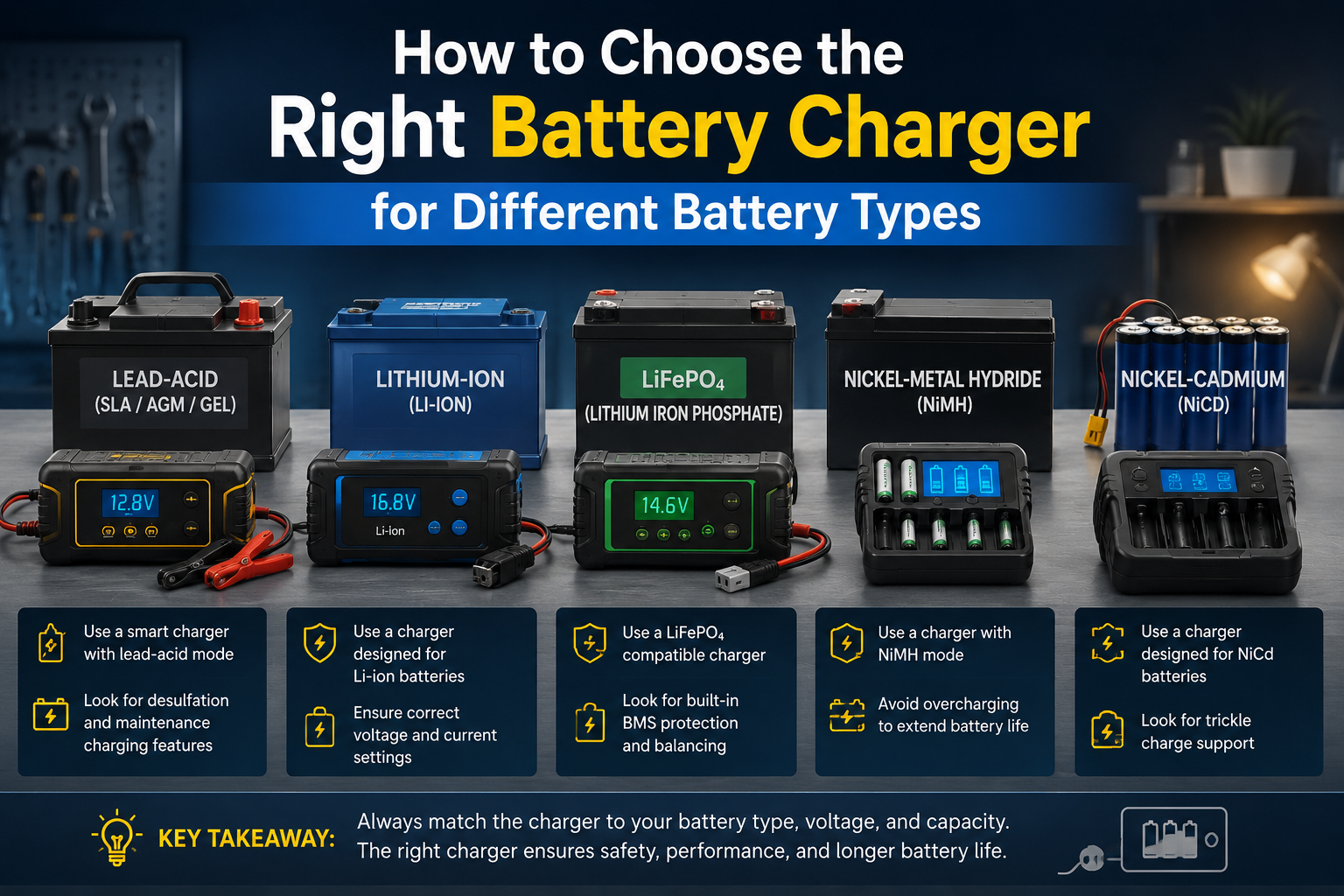
How to Choose the Right Battery Charger for Different Battery Types
Choosing the right battery charger is just as important as choosing the battery itself. A charger that matches the battery chemistry, voltage, and capacity helps the battery charge safely, perform better, and last longer. A wrong charger, on the other hand, can cause slow charging, overheating, reduced battery life, or even permanent damage.
This is especially important because not all batteries are built the same. Lead-acid, AGM, gel, lithium-ion, and other battery types all have different charging needs. If you use batteries for vehicles, solar systems, inverters, backup power, or devices, understanding charger compatibility can save you time, money, and frustration.
Why charger choice matters
A battery charger is not just a power source. It controls how current and voltage are delivered into the battery. Different battery types need different charging profiles, and a charger designed for one chemistry may not work properly with another.
For example, lithium batteries require chargers built specifically for lithium charging, while lead-acid batteries often need multi-stage charging to avoid overcharging and improve battery life. Matching the charger to the battery type is one of the simplest ways to protect your investment.
Step 1: Identify your battery type
The first thing you should do is check the battery label or product documentation. Most batteries clearly mention whether they are flooded lead-acid, AGM, gel, lithium, or another type. If the battery chemistry is not obvious, you should check the manufacturer’s datasheet before buying a charger.
Common battery types include:
- Flooded or wet cell lead-acid batteries.
- AGM batteries.
- Gel batteries.
- VRLA batteries.
- Lithium batteries.
Each one has different charging voltage and current requirements, so a universal charger is not always the safest choice unless it supports the exact chemistry you need.
Step 2: Match the charger to the battery chemistry
Battery chemistry is the most important factor when choosing a charger. A charger that works well for an AGM battery may not be suitable for a lithium battery. Likewise, a charger for flooded lead-acid batteries may damage a gel battery if it applies the wrong charging profile.
Here is the basic rule:
- Use a lead-acid charger for flooded batteries.
- Use an AGM-compatible charger for AGM batteries.
- Use a gel-compatible charger for gel batteries.
- Use a lithium-specific charger for lithium batteries.
Many smart chargers offer multiple modes, which can be useful if you charge more than one battery type. But even then, you must make sure the correct mode is selected before charging.
Step 3: Check voltage compatibility
The charger voltage must match the battery voltage. A 12V battery should be charged with a 12V charger, and a 24V battery needs a 24V charger. Using the wrong voltage can prevent charging or damage the battery system.
This is especially important in larger setups such as solar systems, inverter banks, marine systems, and electric mobility applications. Always verify the nominal voltage before plugging in a charger.
Step 4: Choose the right charging current
Charging current, measured in amps, affects how fast the battery charges. A charger with too little current may take too long, while a charger with too much current may overheat or shorten battery life.
As a general guide, many sources recommend selecting a charger with a current rating around 10% to 20% of the battery’s amp-hour capacity for standard charging, while keeping within the manufacturer’s specified limits. For lithium batteries, the acceptable charge current can vary widely, so you should always check the battery manufacturer’s recommendations.
For example:
- A 100Ah battery may work well with a 10A charger.
- A larger deep-cycle battery may require a charger with a higher amp rating.
- A maintenance charger for stored batteries may use a lower current.
The key is to balance charging speed with battery safety.
Step 5: Decide whether you need charging or maintenance
Not every battery charger is used for the same purpose. Some chargers are meant to restore a flat battery, while others are designed to keep a battery topped up over long periods. If you store a motorcycle, car, boat, or backup battery for weeks at a time, you may need a maintenance charger or trickle charger rather than a high-output charger.
A maintenance charger helps prevent self-discharge and keeps the battery ready for use. This is useful for seasonal vehicles, standby power systems, and rarely used equipment.
Step 6: Look for smart charging features
Modern smart chargers are much safer and more efficient than basic chargers. They often include automatic shutoff, multi-stage charging, temperature control, and protection against overcharging or short circuits. These features help protect the battery and make charging more convenient.
Useful features to look for include:
- Overcharge protection.
- Reverse polarity protection.
- Short-circuit protection.
- Temperature compensation.
- Battery diagnostics.
- Multi-stage charging modes.
If you want reliable performance and less manual monitoring, smart chargers are usually the better choice.
Step 7: Consider the battery’s application
The best charger depends not just on battery chemistry, but also on how the battery is used. A battery in a solar system has different needs from a battery in a car, motorcycle, wheelchair, boat, or backup inverter. Some systems need fast charging, while others need slow, gentle charging to preserve battery health.
For example:
- Vehicle batteries may need quick replenishment.
- Solar batteries may need long-duration, controlled charging.
- Backup batteries may need float charging.
- Lithium packs may need highly specific voltage control.
Always choose the charger with the application in mind, not just the battery label.
Step 8: Check manufacturer specifications
Even when you understand the battery type, the final decision should come from the manufacturer’s charging guidelines. Datasheets usually include the recommended charging voltage, current range, and any special precautions. This is especially important for lithium batteries, where charging requirements can vary significantly.
If the battery label does not show enough information, refer to the product manual or manufacturer support. This is the safest way to avoid mismatches and extend battery life.
Step 9: Avoid common mistakes
Many battery charging problems happen because users guess instead of checking compatibility. One of the most common mistakes is using a charger that supports the wrong chemistry. Another is choosing a charger based only on price without checking voltage or amp rating.
Common mistakes to avoid:
- Charging lithium batteries with non-lithium chargers.
- Using the wrong voltage charger.
- Selecting too much current for the battery size.
- Ignoring manufacturer instructions.
- Using a basic charger for long-term maintenance needs.
Avoiding these mistakes can greatly improve battery lifespan and safety.
Step 10: Choose quality over the cheapest option
A cheap charger may look like a good deal, but it can end up costing more if it damages the battery. A quality charger with the right safety features and smart charging profile is usually worth the investment. Good chargers also tend to last longer and perform more consistently.
When comparing chargers, look at build quality, protection features, charging modes, and customer support—not just the price tag. A reliable charger helps protect one of the most expensive parts of your power system: the battery itself.
The right battery charger depends on battery chemistry, voltage, current, and intended use. If you match the charger carefully to the battery type and follow the manufacturer’s guidance, you can improve charging efficiency, extend battery life, and reduce the risk of damage.
The safest approach is simple: identify the battery type, verify the voltage, check the amp-hour capacity, and choose a charger designed for that exact chemistry. Whether you are charging a car battery, inverter battery, solar battery, or lithium pack, the right charger makes all the difference.
FAQs
How do I know which battery charger to buy?
Check the battery chemistry, voltage, amp-hour capacity, and manufacturer recommendations before buying a charger.
Can I use one charger for different battery types?
Only if the charger specifically supports multiple battery chemistries and you select the correct mode for each battery.
Is a smart charger better than a normal charger?
Yes, smart chargers are usually safer because they adjust charging stages automatically and help prevent overcharging.
What happens if I use the wrong charger?
Using the wrong charger can cause slow charging, overheating, poor battery performance, or permanent battery damage.
How much charging current should I use?
A common rule is to choose a charger around 10% to 20% of the battery’s amp-hour rating, but always check the manufacturer’s recommendation.
