
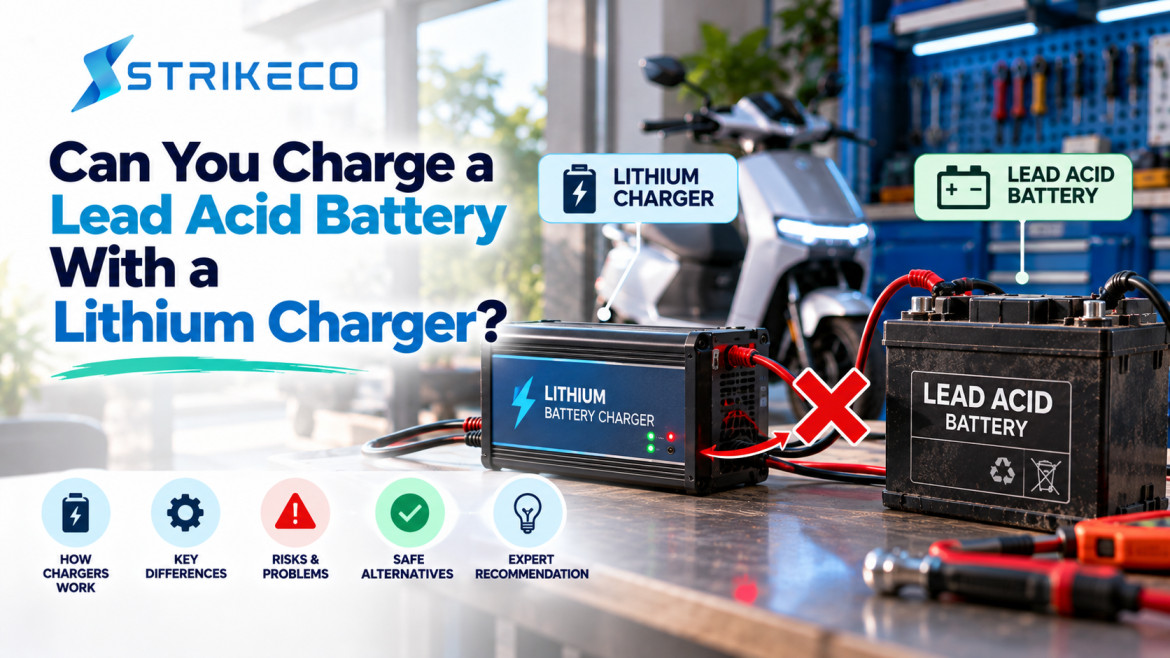
Can You Charge a Lead Acid Battery With a Lithium Charger?
If you own an electric scooter, electric vehicle, or battery-powered system, you may wonder whether you can use a lithium battery charger to charge a lead acid battery. Both chargers supply electrical power, and some models have similar voltage ratings. However, that does not mean they are interchangeable.
In general, you should not use a lithium battery charger for a lead acid battery unless the charger manufacturer explicitly confirms that it supports the specific lead acid battery type. Voltage compatibility alone is not enough because different battery chemistries require different charging profiles.
In this guide, we explain the differences between lithium and lead acid chargers, the risks of using an incompatible charger, and how to select the right option.
1. Why Are Lithium and Lead Acid Chargers Different?
Lithium-ion and lead acid batteries use different chemical processes to store and release energy. Their charging requirements therefore differ.
A battery charger controls the voltage and current supplied during charging. Depending on its design, it may also manage multiple charging stages, temperature compensation, and the transition to a maintenance or float mode.
Lead acid batteries commonly use bulk, absorption, and, where appropriate, float charging stages. Lithium batteries require a charging profile suitable for their specific chemistry and battery-management requirements.
Using the wrong charging profile can result in incomplete charging, excessive voltage, overheating, or battery damage.
2. Can a Lithium Charger Charge a Lead Acid Battery?
The answer depends on the charger design, but you should not assume that it is compatible.
A lithium charger may be unsuitable for a lead acid battery because:
- Its output voltage may not match the battery’s charging requirements.
- Its charging algorithm may not provide the correct stages for lead acid chemistry.
- It may not include the appropriate float or maintenance-charging behaviour.
- Its safety controls may be designed for a different battery chemistry.
Some chargers support multiple battery types through selectable charging modes. Such a charger may be suitable if the manufacturer explicitly lists the exact lead acid battery type as compatible and the correct mode is selected.
For more information, review the manufacturer’s guidance on selecting the correct battery charging mode from CTEK.
3. What Happens If You Use the Wrong Charger?
Using an incompatible charger can affect battery performance, lifespan, and safety.
Incorrect charging voltage
If the charger supplies a voltage that is too high or too low for the battery, it may fail to charge it properly or cause damage.
Overcharging
Excessive charging can cause a lead acid battery to heat up and, depending on its construction and charging conditions, release gas. Overcharging can also shorten battery life.
Incomplete charging
A charger that terminates charging at an unsuitable point may leave the battery undercharged. Repeated undercharging can affect lead acid battery performance and service life.
Reduced battery lifespan
Repeated exposure to unsuitable charging conditions can accelerate battery deterioration, leading to reduced capacity and more frequent replacement.
For these reasons, do not connect a lithium charger to a lead acid battery simply because the connector fits or the voltage rating looks similar.
4. Does Matching the Voltage Make a Charger Compatible?
No. Matching nominal voltage is necessary, but it does not establish full compatibility.
For example, a battery pack labelled 48V requires a charger designed for that pack’s actual charging specifications. The required charging voltage may be different from its nominal voltage, and the correct value depends on battery chemistry and configuration.
Before choosing a charger, check:
- Battery chemistry and type.
- Nominal battery voltage and required charging voltage.
- Maximum permitted charging current.
- Charging profile recommended by the battery manufacturer.
- Connector type and polarity.
- Any requirements specified by the battery-management system.
This is especially important for electric vehicles, where several batteries may be connected together to form a battery pack.
5. How to Choose the Right Charger for a Lead Acid Battery
Selecting the correct charger is straightforward when you follow a few basic steps.
Step 1: Identify the battery type.
Confirm whether your battery is flooded lead acid, AGM, or gel. These types may have different charging requirements.
Step 2: Check the voltage rating.
Read the battery label and manufacturer documentation to identify the required charger voltage.
Step 3: Confirm the charging current.
Choose a charger that supplies a current within the battery manufacturer’s permitted range. A higher-current charger is not automatically a better choice.
Step 4: Check the charging profile.
Ensure that the charger supports the specific battery chemistry and its recommended charging stages.
Step 5: Review safety features.
Look for suitable protection against overcharging, overheating, short circuits, and reverse polarity, as applicable to the model.
If you need a compatible charger, you can compare the Strikeco lead acid battery charger range. Review each product’s voltage and current specifications before purchasing.
6. What If You Need a Lithium Battery Charger?
If your battery is lithium-ion, use a charger designed for its specific chemistry and charging requirements.
Check the battery manufacturer’s recommended charging voltage, current limits, connector, and battery-management-system requirements. Not every lithium battery uses the same charging specifications.
Strikeco offers a separate lithium-ion battery charger range with different voltage and current options. Confirm the compatibility of the particular charger with your battery before ordering.
The key is to match the charger to the battery—not simply to choose a model with the same voltage label.
7. Should You Buy a Separate Charger for Each Battery Type?
If you regularly use both lead acid and lithium batteries, a dedicated compatible charger for each type is often the simplest option.
A separate charger reduces the risk of accidentally selecting the wrong charging mode and makes it easier to follow the battery manufacturer’s instructions.
A multi-chemistry charger can also be suitable, provided it explicitly supports both battery types, offers the correct charging profiles, and is configured correctly for each battery.
If you are replacing a battery and charger together, you can explore the Strikeco lead acid battery range and its compatible charger options.
Frequently Asked Questions
1. Can I use a lithium charger for a 12V lead acid battery?
Only if the charger manufacturer explicitly confirms compatibility with that lead acid battery and its required charging profile. A matching 12V nominal rating alone is not sufficient.
2. Will a lithium charger damage a lead acid battery?
It can, depending on the charger’s voltage, charging algorithm, and safety controls. An incompatible charger may cause overcharging, incomplete charging, overheating, or reduced battery life.
3. Can one charger support both lead acid and lithium batteries?
Yes, some chargers support multiple chemistries through selectable charging modes. Check the manufacturer’s specifications and select the correct mode before connecting the battery.
4. Is a lead acid charger suitable for a lithium battery?
Not necessarily. The same compatibility rules apply in reverse. A lead acid charger should only be used for a lithium battery when the battery manufacturer explicitly approves that charger or charging profile.
5. How do I know which charger is suitable for my battery?
Check the battery chemistry, voltage, permitted charging current, connector, and manufacturer’s charging recommendations. If any detail is unclear, contact the battery or charger supplier before connecting it.
A lithium battery charger and a lead acid battery charger are not automatically interchangeable. Even when their nominal voltage ratings match, their charging profiles and safety requirements may differ.
Always follow the battery manufacturer’s recommendations and use a charger explicitly approved for your battery type. If you need a replacement, explore the Strikeco lead acid charger range or the Strikeco lithium-ion charger range and verify compatibility before making a purchase.
