
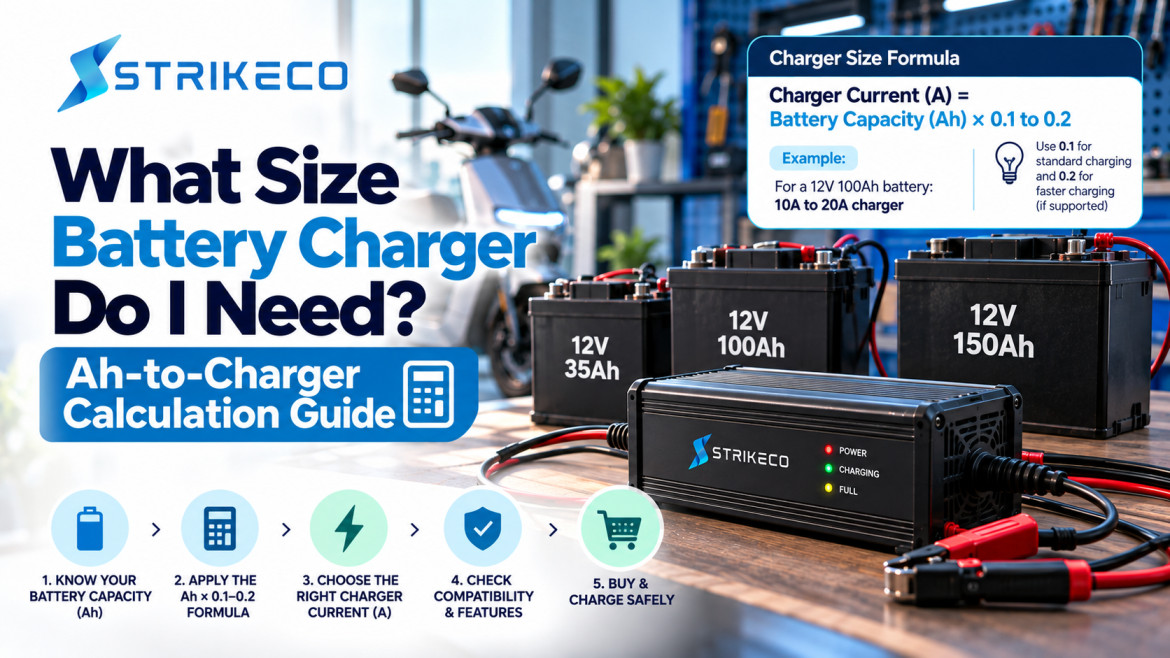
What Size Battery Charger Do I Need? Ah-to-Charger Calculation Guide
Choosing the right battery charger can be confusing if you are unsure how battery capacity, voltage, and charging current work together. A charger that is too small may take longer to charge your battery, while an unsuitable charger with excessive current or the wrong voltage can damage it.
Whether you are charging an electric vehicle battery, an inverter battery, or another lead acid battery system, understanding the relationship between amp-hours (Ah) and charging current helps you make a better decision.
In this guide, we explain how to calculate the approximate charger size and choose a compatible model.
1. Understand Battery Ah and Charger Amps
Before calculating charger size, it is important to understand two basic terms.
- Amp-hour (Ah): Indicates a battery’s capacity. For example, a 100Ah battery is rated to deliver a specified current over time under defined test conditions.
- Amp (A): Measures electrical current. A charger rated at 5A can supply up to its specified charging current under the stated operating conditions.
Battery capacity and charger current are related, but they are not interchangeable. A 100Ah battery does not automatically require a 100A charger.
The correct charger depends on the battery’s voltage, chemistry, capacity, recommended charging rate, and the manufacturer’s instructions.
2. How to Calculate Battery Charger Size
A useful starting point is to estimate charging current as a percentage of battery capacity.
For some lead acid batteries, a charging current around 10% of the Ah rating may be a reasonable initial estimate. However, the appropriate charging rate varies by battery design and manufacturer, so this is a guideline rather than a universal rule.
Formula:
Recommended starting current (A) = Battery capacity (Ah) × Charging-rate percentage
For a 100Ah battery using an illustrative 10% charging rate:
100Ah × 0.10 = 10A
This gives an estimated charging current of 10A, provided the battery manufacturer permits that rate.
Battery Ah-to-charger calculation examples
| Battery capacity | Illustrative 10% current | Important consideration |
|---|---|---|
| 20Ah | 2A | Check the battery’s minimum and maximum charging current |
| 40Ah | 4A | Confirm compatibility with the battery type |
| 60Ah | 6A | Check the manufacturer’s recommended charging rate |
| 100Ah | 10A | Confirm the permissible current before selecting a charger |
| 150Ah | 15A | Check whether the battery supports the proposed charging current |
These figures are examples for understanding the calculation, not universal charger recommendations. The battery manufacturer’s specifications should always take priority.
3. How Long Will It Take to Charge a Battery?
Charging time depends on battery capacity, charger current, charging efficiency, the battery’s initial state of charge, and the charging profile.
A simple estimate is:
Approximate charging time (hours) = Battery capacity to be replenished (Ah) ÷ Charger current (A)
For example, suppose a 100Ah battery needs approximately 50Ah replenished and the charger supplies 10A.
50Ah ÷ 10A = 5 hours
Actual charging time will generally be longer because charging is not perfectly efficient and the current may decrease as the battery approaches full charge.
For lead acid batteries, the absorption stage can add significant time. Do not rely on this basic formula as an exact charging-time prediction.
4. Match the Charger Voltage to the Battery
Battery voltage is just as important as charger current. A charger with an unsuitable voltage can fail to charge a battery correctly or cause damage.
Before purchasing a charger, verify:
- The nominal voltage of the battery or battery pack.
- The charger’s specified battery-voltage compatibility.
- The required charging voltage for the battery chemistry.
- The connector type and polarity.
- Whether the charger supports the battery’s configuration.
For example, Strikeco lists different lead acid charger models, including a 60V/3A charger and a 72V/5A charger.
These models have different voltage and current ratings. Select one only after confirming that it matches your battery system and charging requirements.
5. Does Battery Type Affect Charger Size?
Yes. Battery chemistry affects the required charging voltage, current limits, and charging profile.
Lead acid batteries
Flooded, AGM, and gel lead acid batteries can have different charging requirements. Use a charger that supports the specific type of battery and follows its recommended charging profile.
Lithium-ion batteries
Lithium-ion batteries require charging settings appropriate to their particular chemistry and battery-management system. Do not choose a charger based only on Ah capacity or nominal voltage.
If you need a charger for a lithium battery, explore the Strikeco lithium-ion charger range and verify the compatibility of the specific model before buying.
6. What Happens If the Charger Is Too Small or Too Large?
Choosing the wrong charger can affect charging time, safety, and battery life.
If the charger current is too low:
- Charging may take longer than expected.
- The battery may not reach a full charge if charging is interrupted.
- The charger may not be practical for your usage schedule.
If the charger current is too high:
- The battery may overheat or suffer damage.
- Excessive charging current may reduce battery life.
- Safety risks can increase if the charger lacks suitable controls.
The aim is not to choose the highest-current charger available. It is to choose a charger that matches the battery’s voltage, chemistry, capacity, and permitted charging rate.
7. How to Choose the Right Charger Before Buying
Use this checklist before ordering a battery charger:
- Identify battery capacity: Find the Ah rating printed on the battery label or datasheet.
- Check voltage: Confirm the nominal voltage of the battery or complete battery pack.
- Identify battery chemistry: Determine whether it is flooded lead acid, AGM, gel, or lithium-ion.
- Check charging limits: Find the manufacturer’s recommended charging current and voltage.
- Confirm compatibility: Check the charger model, connector, polarity, and charging profile.
- Compare price and warranty: Review the total price, warranty conditions, and seller support.
You can compare the available models in the Strikeco lead acid charger range. For battery replacement or a new installation, you can also review the Strikeco lead acid battery range.
Always verify current product specifications, availability, and warranty terms before placing an order.
Frequently Asked Questions
1. What size charger do I need for a 100Ah lead acid battery?
A 10A charger may be a reasonable starting estimate if the battery manufacturer permits a charging rate of around 10% of capacity. Confirm the battery voltage, chemistry, and recommended charging current before selecting a charger.
2. How many amps should a battery charger have?
The required current depends on the battery’s Ah rating and its permitted charging rate. Use the manufacturer’s recommendations rather than selecting a charger based on capacity alone.
3. Can I use a 10A charger for a 150Ah battery?
It may be suitable if the charger voltage and charging profile match the battery and the manufacturer permits that current. Charging will generally take longer than with a compatible higher-current charger.
4. How do I calculate battery charging time?
Divide the Ah capacity that needs replenishing by the charger’s current in amps to estimate the basic charging time. Allow additional time for charging losses and the battery’s charging stages.
5. Can I use the same charger for lead acid and lithium-ion batteries?
Not unless the charger is explicitly designed and approved for both battery chemistries and the specific battery requirements. Use a compatible charger to avoid charging problems and potential damage.
Conclusion
Calculating charger size becomes easier when you understand battery capacity, voltage, and charging current. The Ah-to-amp calculation provides a useful starting estimate, but the battery manufacturer’s charging specifications determine the correct charger.
Before purchasing, confirm the battery chemistry, voltage, recommended charging current, and connector compatibility. Explore the Strikeco lead acid charger range to compare available options and select a model suited to your battery.
