
Lead Acid Battery Price Comparison in India: How to Tell Real Value From a Cheap Deal
Short answer: The lowest price in a lead acid battery price comparison isn’t automatically the best value — a genuinely good deal matches the same Ah rating, discharge standard, plate technology, and warranty terms as the alternatives you’re comparing it against, backed by a verifiable brand and real service support. A battery priced well below comparable listings is usually cheap for a specific, identifiable reason, not because you found a better deal than everyone else.
If you’ve lined up a few lead acid battery listings side by side and one price stands out as noticeably lower, it’s tempting to treat that as the winner. Sometimes it genuinely is a good deal. Often, it’s cheap because something in the comparison isn’t actually equal. Here’s how to tell the difference before you order.
Why “Cheapest” and “Best Value” Are Different Questions
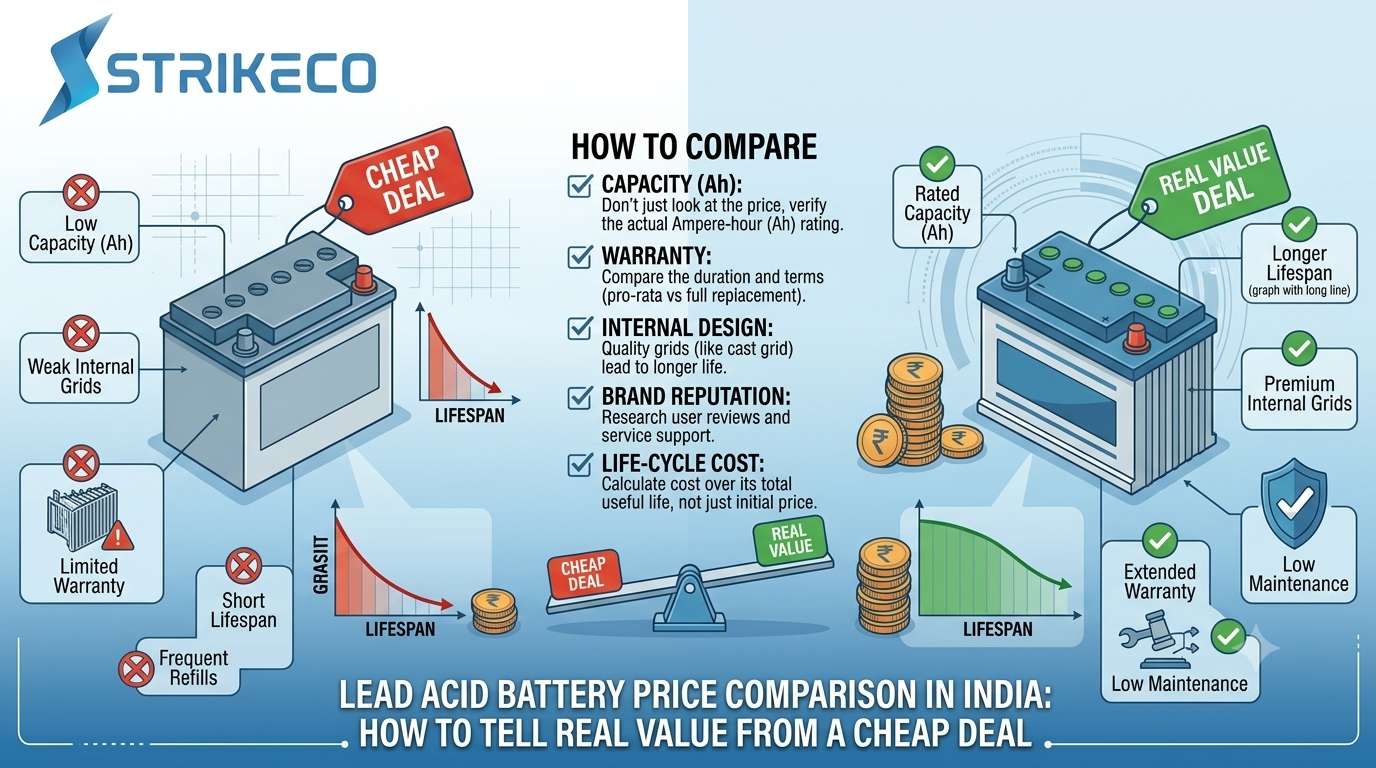
Price comparison only works when you’re comparing the same thing. Our earlier breakdown of what determines lead acid battery pricing covers this in depth, but the short version: Ah capacity, discharge rating, plate technology, brand, and warranty terms all move price independently. A listing that looks like a bargain is very often just missing one of these — a shorter warranty, a lower discharge standard, or an unverified brand — rather than genuinely underpricing an equal product.
“Best value” accounts for all of that together. “Cheapest” only accounts for the number on the page.
Red Flags in a Suspiciously Cheap Listing
1. No clear discharge rating disclosed. If a listing shows an impressive Ah number but doesn’t specify whether it’s rated at C10 or C20, that omission is often doing real work to make the number look better than the battery’s actual usable capacity.
2. Vague or missing warranty terms. “Warranty included” with no specific duration, no documentation process, and no mention of what’s actually covered is a strong signal the warranty may not be reliably honored if you ever need it.
3. Unfamiliar or unverifiable brand name. A brand with no findable service network, no verifiable manufacturing information, and no independent reviews outside the listing itself is a real risk, regardless of how good the specifications look on paper.
4. Prices dramatically below every comparable listing. When one price sits far below a cluster of similarly specified competitors, that’s rarely a sign you found the one honest seller — it’s more often a sign of a mismatched specification, old stock, or a battery that won’t perform as advertised.
5. No physical specification sheet or datasheet available. A seller confident in their product can usually provide a proper datasheet on request. Reluctance or inability to do so is worth treating as a warning sign, not a minor inconvenience.
6. Reviews mentioning early failure or unresponsive support. Even a handful of reviews describing a battery that died well before its expected life, or a seller that went quiet after the sale, tells you more than the listing’s own marketing copy ever will.
The Real Metric: Total Cost of Ownership, Not Sticker Price
A cheaper battery that fails in two years costs more per year of actual use than a moderately pricier battery that reliably lasts five or more. This is the calculation a pure price comparison misses entirely — the sticker price is only half the equation. When comparing options, it’s worth mentally dividing the price by the expected service life to get a rough cost-per-year figure, rather than comparing upfront cost alone.
This doesn’t mean the most expensive option is automatically the best value either — it means the comparison needs to include expected lifespan and warranty-backed reliability, not just the number at checkout.
A Simple Checklist for Fair Comparison
Before deciding based on price, confirm each listing you’re comparing has:
- The same Ah capacity, measured at the same discharge standard (C10 or C20)
- The same plate technology category (flat-plate, tubular, or SMF/VRLA — not mixed across categories)
- A specific, documented warranty period, not a vague claim
- A verifiable brand with a real, reachable service network
- Available specification sheets or datasheets on request
- Independent reviews or reputation beyond the listing’s own claims
If a cheaper option still checks every one of these boxes against a pricier alternative, it may genuinely be the better deal. If it fails several of them, the lower price is very likely explaining itself.
Common Tricks to Watch For
- Labeled capacity that doesn’t match real-world performance — sometimes from a lower, undisclosed discharge rating used to inflate the advertised Ah number
- Old stock sold as new, which can already have reduced capacity and shortened remaining life before it even reaches you
- Counterfeit or imitation branding designed to resemble an established, trusted brand name closely enough to create false confidence
- Bundled “warranty” that isn’t actually documented or traceable to a serial number or purchase record
How to Actually Compare Before You Buy
- Shortlist 2–3 listings with genuinely matching specifications using the checklist above
- Confirm warranty terms directly with each seller, not just what’s written in the listing
- Factor in exchange value if you’re replacing an old battery, since it changes your real net cost
- Weigh expected service life against price, not price alone
- Only then, compare the remaining, verified options on price
A real lead acid battery price comparison in India isn’t about finding the single lowest number — it’s about confirming you’re comparing equivalent products, then weighing total cost of ownership and warranty-backed reliability alongside price. A battery priced noticeably below its comparable alternatives is usually cheap for a specific, findable reason. Our lead acid battery range lists full, transparent specifications for exactly this kind of comparison — and if you haven’t already, it’s worth reviewing what to check before you place an order as well.
Frequently Asked Questions
Is the cheapest lead acid battery always a bad choice?
Not necessarily — but a price significantly below comparable listings usually reflects a real difference somewhere (warranty, discharge rating, brand verification, or stock age), not simply a better deal. Confirm the specifications match before assuming it’s genuinely cheaper for the same product.
How do I fairly compare lead acid battery prices between different sellers?
Confirm the Ah capacity, discharge standard (C10 vs. C20), plate technology, and warranty terms are the same across listings before comparing price — comparing mismatched specifications is the most common reason a price comparison feels confusing or misleading.
What’s more important: price or warranty length?
Both matter, but warranty length is often a better indicator of the manufacturer’s confidence in the product’s build quality. A significantly cheaper battery with a much shorter warranty may end up costing more over its real service life.
How can I tell if a battery brand is legitimate before buying?
Check for a verifiable service network, independent reviews outside the seller’s own listing, and a willingness to provide a proper specification sheet on request. A brand that’s difficult to verify independently is a genuine risk regardless of its advertised specifications.
Does a lower price always mean lower quality?
Not always — but it should prompt closer verification rather than being taken at face value. Confirm the specifications, warranty, and brand legitimacy match what you’d expect before treating a lower price as a genuine bargain.
