
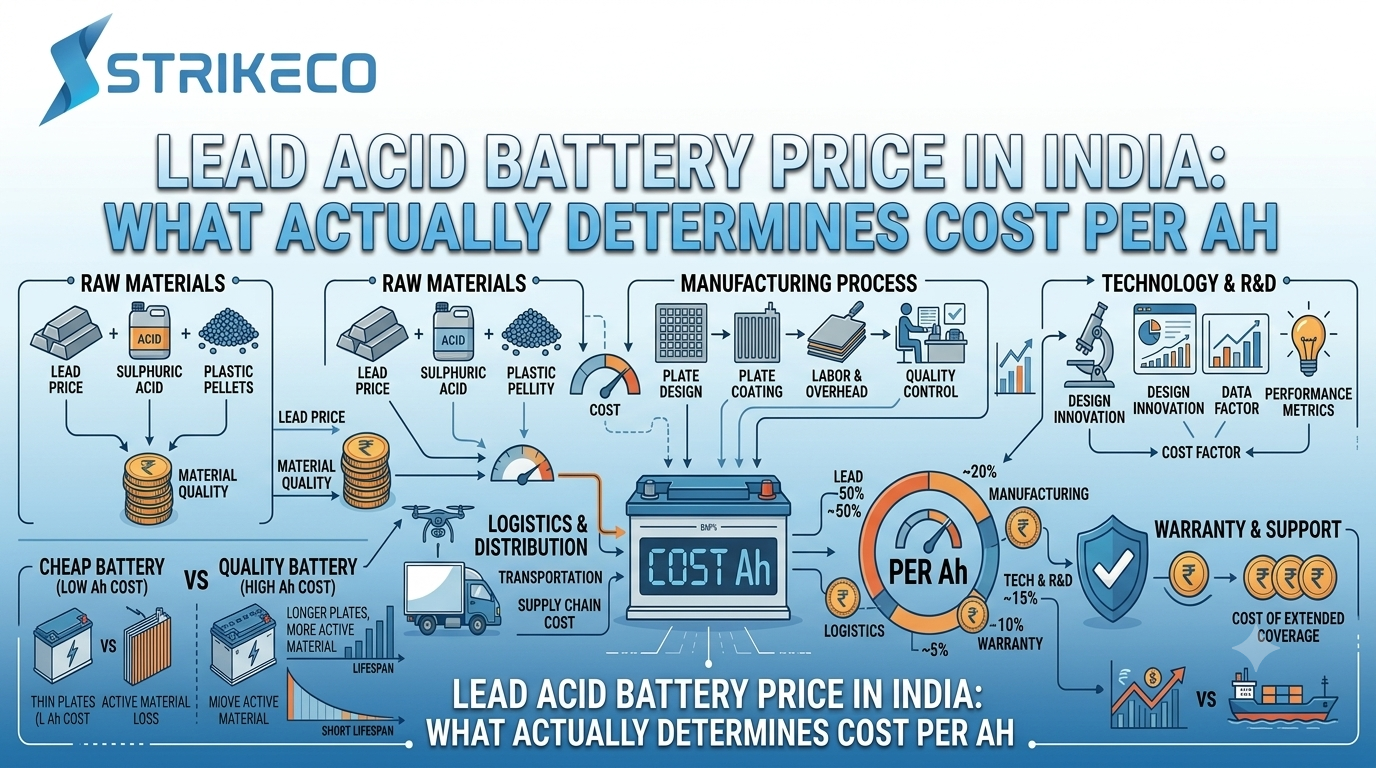
Lead Acid Battery Price in India: What Actually Determines Cost Per Ah
SEO Title (59 characters): Lead Acid Battery Price in India: What Determines Cost/Ah
Meta Description (156 characters): Why do two batteries with the same Ah rating cost differently? Here’s exactly what determines lead acid battery price per Ah in India.
URL Slug: /lead-acid-battery-price-india-cost-per-ah/
Short answer: Lead acid battery price per Ah in India is determined primarily by the global price of lead (the single biggest input cost), followed by plate technology (flat-plate vs. tubular vs. SMF/VRLA), the specific Ah capacity, the discharge rate the battery is rated at (C10 vs. C20), brand and service network, and warranty length. Two batteries can carry the identical Ah number on the label and still differ by several thousand rupees for entirely legitimate reasons — knowing what those reasons are is what lets you compare prices fairly instead of just picking the lowest number.
If you’ve compared lead acid battery prices online and found the numbers all over the place for what looks like the same product, you’re not imagining it. Here’s what’s actually driving that difference.
The Biggest Lever: The Price of Lead Itself
A lead acid battery is, fundamentally, lead plates sitting in dilute sulphuric acid inside a hard plastic case — and lead is a globally traded commodity, priced through international benchmarks like the London Metal Exchange (LME) and domestic platforms like India’s MCX. When the price of lead moves, it quietly reprices every battery in the market, regardless of brand. This is why battery prices can shift over a matter of weeks even when nothing about the product itself has changed — it’s simply tracking the raw material market underneath it.
Plate Technology: Flat-Plate vs. Tubular vs. SMF/VRLA
The internal construction of the battery is the next major cost driver:
- Flat-plate (flooded/wet) batteries — typically the most affordable option, common in standard inverter batteries, but require periodic water top-up.
- Tubular batteries — cost more than flat-plate due to their construction, but generally offer a longer service life, which is why they dominate the backup power market despite the higher upfront price.
- SMF/VRLA (sealed, maintenance-free) batteries — a different sealing technology built for UPS-duty cycling, priced differently again and not directly comparable to flooded flat-plate types on a simple per-Ah basis.
Comparing prices across these categories as if they’re interchangeable is one of the most common ways buyers end up confused about “fair” pricing — a flat-plate and a tubular battery at the same Ah rating are not the same product.
Capacity (Ah) — But Not Always in a Straight Line
Higher Ah capacity means more lead and more internal plate material, so cost increases with capacity — but not always in a perfectly linear way. Larger-capacity batteries often carry a proportionally higher price step than smaller ones, since they require more raw material per unit and sometimes different construction to handle the added capacity reliably.
The Detail Most Buyers Miss: Discharge Rating (C10 vs. C20)
This is a genuinely underappreciated factor in fair price comparison. A battery’s Ah rating is measured against a specific discharge rate — commonly C10 or C20 — and the same physical battery can show a different effective Ah number depending on which standard it’s tested against. When comparing lead acid battery price per Ah across two listings, confirming both are rated at the same discharge standard is necessary for the comparison to actually mean anything — otherwise you may be comparing two genuinely different specifications that happen to share a similar-looking number.
Brand and Service Network
Established brands with dense service and distribution networks typically command a real premium over lesser-known alternatives at similar specifications — commonly in the range of 8–15% for comparable specs in the broader battery market. This isn’t purely a markup — a stronger service network usually means faster warranty support and more accessible replacement if something goes wrong, which is a real, tangible value even if it doesn’t show up in the spec sheet.
Warranty Length and Type
A longer or more comprehensive warranty adds cost, but it also reflects the manufacturer’s own confidence in the product’s build quality. When comparing two similarly priced batteries, a meaningfully shorter warranty on the cheaper option is often where the real cost difference is actually hiding.
Don’t Forget Old-Battery Exchange Value
Many battery purchases in India involve exchanging an old battery, and that exchange value directly affects your real out-of-pocket cost — the “list price” and the actual amount you pay are often two different numbers. Old lead acid battery scrap has genuine, tracked commodity value (recent 2026 market data has placed it in the range of roughly ₹70–72 per kg, though this fluctuates with the same commodity market that drives new battery pricing), so it’s worth treating the exchange value as a real, negotiable part of the total cost rather than an afterthought.
Indicative Price Ranges (For Reference Only)
As a general illustration of how these factors show up in real listings, 2026 market data for tubular inverter batteries has placed 150Ah batteries roughly in the ₹14,000–20,000 range and 200Ah batteries roughly in the ₹18,000–26,000 range, net of typical exchange schemes — with the exact number depending on brand, current lead prices, and warranty terms. Treat this as an illustration of the spread, not a quote — get current pricing directly for the specific battery and Ah capacity you need.
How to Compare Prices Per Ah Fairly
- Confirm both batteries are rated at the same discharge standard (C10 vs. C20)
- Confirm you’re comparing the same plate technology (flat-plate vs. tubular vs. SMF/VRLA), not different categories
- Factor in warranty length and type, not just the sticker price
- Ask what the actual exchange/buyback value is, since it changes your real net cost
- Weigh brand and service network against pure price — a slightly higher price with a stronger support network is often the better value, not just the safer choice
Lead acid battery price per Ah in India isn’t arbitrary — it’s driven by the underlying lead commodity market, the specific plate technology, the discharge rating the Ah figure is measured against, brand and service network, and warranty terms. Once you know how to compare on these factors rather than the sticker price alone, it becomes much easier to tell a genuinely good deal from a mismatched or misleading one. If you’re ready to compare real options, our lead acid battery range lists full specifications for exactly this kind of comparison — and if you haven’t yet, it’s worth reading what to check before you buy and how to order one online as well.
Frequently Asked Questions
Why do two lead acid batteries with the same Ah rating have different prices?
Because the Ah number alone doesn’t capture everything that affects cost — plate technology, discharge rating (C10 vs. C20), brand, warranty length, and current lead commodity prices all factor in, even when the labeled Ah capacity looks identical.
Why does lead acid battery pricing change over time even for the same model?
Because lead is a globally traded commodity priced through markets like the LME and India’s MCX. As the underlying commodity price moves, battery prices shift with it, independent of anything changing about the product itself.
Is a tubular battery always worth the higher price over a flat-plate battery?
For most backup power applications, tubular batteries’ longer service life often justifies the higher upfront cost, but the right choice depends on your specific usage pattern and budget — flat-plate remains a reasonable, more affordable option for many standard inverter setups.
Does old battery exchange really affect the price I pay?
Yes, meaningfully — exchange value is tied to genuine, tracked commodity pricing for battery scrap, and can represent a real portion of your total cost. It’s worth asking specifically about exchange value rather than only comparing list prices.
What’s the most reliable way to compare lead acid battery prices per Ah?
Confirm both batteries are rated at the same discharge standard, are the same plate technology category, and have comparable warranty terms before comparing price — comparing across mismatched specifications is the most common reason two “same Ah” batteries seem confusingly priced.
