
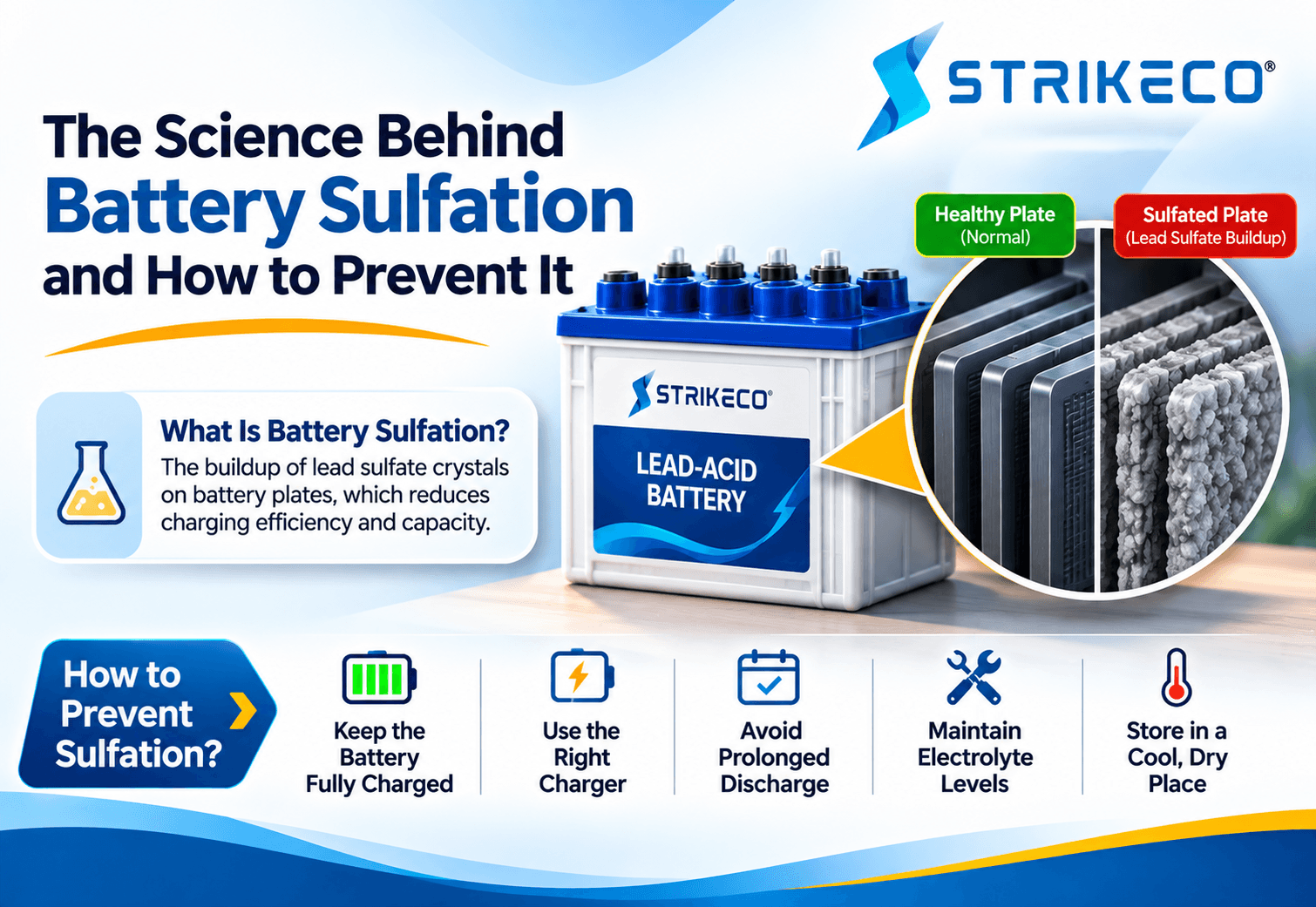
The Science Behind Battery Sulfation and How to Prevent It
Lead-acid batteries are widely used in home inverter systems, backup power solutions, vehicles and industrial applications. They are designed to store and deliver electrical energy through chemical reactions. However, like all batteries, their performance can gradually decline due to ageing, usage patterns and maintenance conditions.
One common reason for reduced performance in lead-acid batteries is sulfation.
Battery sulfation occurs when lead sulfate crystals accumulate on the battery plates. While a certain amount of lead sulfate forms naturally during normal battery operation, problems develop when the battery remains undercharged or discharged for extended periods.
Over time, these deposits can become difficult to convert back during charging, reducing the battery’s ability to store energy.
Understanding the science behind sulfation can help battery owners identify early warning signs and follow suitable maintenance practices.
In this article, we explain what battery sulfation is, why it happens, how it affects performance and what you can do to prevent it.
1. What Is Battery Sulfation?
Sulfation is a chemical process that occurs in lead-acid batteries when lead sulfate accumulates on the positive and negative plates.
To understand this process, it is useful to know how a lead-acid battery works.
A typical lead-acid battery contains:
- Positive plates made of lead dioxide.
- Negative plates made of porous lead.
- An electrolyte consisting of sulphuric acid and water.
- Separators that keep the positive and negative plates apart.
When the battery supplies electricity to an appliance or vehicle, a chemical reaction takes place between the plates and the electrolyte.
During discharge, both plates gradually form lead sulfate (PbSO₄), while the electrolyte becomes more diluted.
When the battery is recharged correctly, this chemical reaction reverses, converting the lead sulfate back into the active materials and restoring the electrolyte concentration.
This process is normal.
However, when a battery remains partially charged or discharged for too long, lead sulfate crystals can grow larger and become harder to convert during charging.
This condition is known as sulfation.
2. The Science Behind Battery Sulfation
Sulfation is directly connected to the chemical reactions that take place inside a lead-acid battery.
During discharge, the simplified overall chemical reaction is:
[
PbO_2 + Pb + 2H_2SO_4
\rightarrow 2PbSO_4 + 2H_2O
]
In this reaction:
- Lead dioxide from the positive plate reacts.
- Lead from the negative plate reacts.
- Sulphuric acid participates in the reaction.
- Lead sulfate and water are produced.
During normal charging, the reaction reverses, restoring the original active materials.
The problem develops when the battery remains undercharged for an extended period.
Small lead sulfate crystals formed during normal operation can gradually grow into larger, more stable crystals. These deposits are harder to convert during ordinary charging.
As sulfation increases:
- The active surface area of the plates becomes less available.
- The battery’s ability to accept charge decreases.
- Internal resistance may increase.
- Available battery capacity gradually reduces.
- Charging and operating performance deteriorate.
Severe sulfation can cause permanent damage and shorten battery service life.
3. What Causes Battery Sulfation?
Several operating and maintenance conditions can contribute to sulfation.
1. Leaving the Battery Discharged
One of the most common causes is leaving a lead-acid battery in a discharged condition for an extended period.
When the battery remains at a low state of charge, lead sulfate deposits can gradually harden on the plates.
This is particularly important for home inverter batteries that may remain unused or partially discharged for long periods.
Prevention: Recharge the battery promptly after discharge and avoid storing it in a discharged condition.
2. Repeated Undercharging
A battery may appear to be charging normally but still fail to reach its required full-charge level.
This can happen because of:
- An incompatible charger.
- Incorrect charging voltage.
- Insufficient charging time.
- Frequent interruptions to charging.
- Faulty charging equipment.
Repeated undercharging allows lead sulfate to accumulate on the plates.
Prevention: Use a compatible charger and follow the manufacturer’s recommended charging procedure.
3. Long Periods of Non-Usage
Even when disconnected, lead-acid batteries gradually lose charge through a process called self-discharge.
If a battery remains unused for several months without appropriate maintenance charging, its charge level can fall sufficiently to encourage sulfation.
Prevention: Store lead-acid batteries fully charged and follow the manufacturer’s recommended inspection and recharge schedule.
4. Frequent Deep Discharges
Repeatedly discharging a battery to very low levels can increase stress on its plates and contribute to premature degradation.
Although batteries are designed to supply energy during discharge, regularly exceeding their recommended depth of discharge can affect their overall service life.
Prevention: Select an appropriate battery capacity for your application and avoid unnecessary deep discharges.
5. Poor Maintenance
In conventional flooded lead-acid batteries, insufficient electrolyte levels can expose parts of the plates to air.
This can cause permanent damage and affect battery performance.
Other maintenance problems, including dirty terminals and unsuitable charging practices, can also contribute to reduced battery reliability.
Prevention: Check electrolyte levels where applicable, use distilled water when topping up and follow the manufacturer’s maintenance instructions.
4. How Does Sulfation Affect Battery Performance?
Sulfation can gradually affect several aspects of battery operation.
| Battery performance area | Effect of sulfation |
|---|---|
| Battery capacity | Reduces the amount of energy the battery can store |
| Charging efficiency | Makes it harder for the battery to accept a full charge |
| Backup duration | Reduces the time connected appliances can operate |
| Internal resistance | May increase as the battery deteriorates |
| Battery lifespan | Can accelerate premature battery failure |
| Operating reliability | May cause inconsistent performance under load |
For example, a home inverter battery that previously supported lights, fans and other essential appliances for several hours may begin providing noticeably shorter backup.
This does not automatically confirm sulfation, as battery ageing, faulty connections, charging problems and other defects can produce similar symptoms.
A proper battery inspection is necessary to identify the cause.
5. What Are the Warning Signs of a Sulfated Battery?
Recognising the early signs of sulfation can help battery owners take appropriate action.
Some common symptoms include:
Reduced Backup Time: The battery provides less backup than before, even when the connected electrical load remains similar.
Difficulty Reaching Full Charge: The battery may take longer to charge or may not reach its expected full-charge condition.
Frequent Charging Requirements: The battery may need charging more often because its usable capacity has reduced.
Unusual Voltage Behaviour: Voltage readings may drop more quickly under load or behave differently during charging.
Poor Performance Under Load: The battery may struggle to operate connected appliances or equipment.
These symptoms can also indicate other battery problems. A qualified technician should check the battery’s voltage, charging system and overall condition before confirming sulfation.
6. How to Prevent Battery Sulfation
Preventing sulfation is generally easier than trying to reverse severe crystal formation.
The following practices can help maintain lead-acid battery performance.
1. Keep the Battery Properly Charged
Avoid leaving the battery discharged for extended periods.
Recharge it according to the manufacturer’s recommendations, particularly after significant discharge.
For applications involving frequent power cuts, ensure the inverter has enough time to recharge the battery fully between usage periods.
2. Use the Correct Charger
Charging voltage and current must match the battery’s specifications.
An unsuitable charger may cause undercharging or overcharging, both of which can reduce battery life.
Use the original or manufacturer-approved charging equipment.
3. Avoid Repeated Deep Discharges
Choose a battery capacity that matches your expected power requirements.
Avoid operating appliances beyond the battery’s recommended discharge limits.
A correctly sized battery can help reduce unnecessary stress during regular usage.
4. Maintain Electrolyte Levels
For serviceable flooded lead-acid batteries, inspect electrolyte levels according to the manufacturer’s maintenance schedule.
When topping up is required:
- Use distilled or manufacturer-approved deionised water.
- Never add ordinary tap water.
- Do not add acid unless specifically instructed by the manufacturer.
- Follow the correct filling procedure.
- Avoid overfilling.
Sealed batteries such as many VRLA and AGM models should not be opened or topped up.
5. Store Batteries Correctly
If a battery will remain unused for an extended period:
- Fully charge it before storage.
- Disconnect it from equipment when appropriate.
- Store it in a cool, dry and ventilated location.
- Check its condition periodically.
- Recharge according to the manufacturer’s instructions.
Do not leave a lead-acid battery discharged during long periods of non-usage.
6. Follow Recommended Equalisation Procedures
Some flooded lead-acid batteries may require periodic equalisation charging to address cell imbalance and electrolyte stratification.
However, equalisation is not suitable for every battery.
It should only be performed when the battery manufacturer recommends it, using the specified equipment and procedure.
Never apply an equalisation charge to sealed or maintenance-free batteries unless the manufacturer explicitly permits it.
7. Can Battery Sulfation Be Reversed?
The possibility of recovering a sulfated battery depends on the severity of the condition.
In some cases, early or mild sulfation may be partially reversible through an appropriate charging process.
Some compatible smart chargers provide a controlled desulphation or recovery mode designed for certain lead-acid batteries.
However, this does not guarantee that the battery will return to its original capacity.
Severe or long-standing sulfation can cause permanent damage to the plates. In such cases, charging treatments may not restore the battery’s performance.
Before attempting recovery:
- Have the battery inspected by a qualified technician.
- Confirm that the charger supports the specific battery type.
- Follow the manufacturer’s recommended charging procedure.
- Avoid unverified DIY desulphation methods.
- Replace the battery if it is damaged or cannot safely retain charge.
Never use improvised chemical treatments or attempt to open a sealed battery to remove sulfate deposits.
8. Which Batteries Are More Affected by Sulfation?
Sulfation is a characteristic issue associated with lead-acid battery chemistry.
It can affect different lead-acid battery designs, including:
- Flat plate batteries.
- Tubular batteries.
- Flooded lead-acid batteries.
- Absorbent Glass Mat (AGM) batteries.
- Gel lead-acid batteries.
The rate and severity of sulfation can vary depending on battery construction, usage, charging practices and storage conditions.
Tubular batteries may offer better cycle performance than comparable flat plate designs, but they are not immune to sulfation.
Proper charging and maintenance remain important regardless of the battery design.
If you are exploring different battery options, you can learn more about Lead acid batteries in India.
9. Battery Maintenance Checklist to Prevent Sulfation
Use this simple checklist to maintain your lead-acid battery.
| Maintenance activity | Recommended practice |
|---|---|
| Charging | Recharge fully according to manufacturer instructions |
| Discharge | Avoid repeated deep discharge |
| Storage | Keep the battery fully charged during storage |
| Electrolyte | Check levels in serviceable flooded batteries |
| Water topping | Use distilled water when required |
| Charger | Use compatible charging equipment |
| Terminals | Keep connections clean and secure |
| Inspection | Check voltage and battery condition periodically |
| Equalisation | Perform only when recommended by the manufacturer |
Following these practices can help reduce the risk of sulfation and support better battery performance.
Battery sulfation is a natural chemical process associated with lead-acid battery operation. While small amounts of lead sulfate form during normal discharge, prolonged undercharging and poor storage practices can cause larger crystals to accumulate on the plates.
This can reduce charging efficiency, available capacity and overall battery lifespan.
The best way to prevent severe sulfation is to maintain proper charging habits, avoid prolonged discharge, use compatible chargers and follow the manufacturer’s maintenance recommendations.
Whether you use a home inverter battery, vehicle battery or industrial backup battery, regular maintenance can help improve reliability and reduce premature battery failure.
Understanding how sulfation develops is an important step towards getting better performance and longer service life from your lead-acid battery.
Frequently Asked Questions (FAQs)
1. What is battery sulfation?
Battery sulfation is the accumulation of lead sulfate crystals on the plates of a lead-acid battery. Excessive crystal formation can reduce the battery’s ability to accept and store charge.
2. What causes sulfation in lead-acid batteries?
Common causes include prolonged undercharging, leaving the battery discharged, repeated deep discharge and improper long-term storage.
3. Can sulfation permanently damage a battery?
Yes. Severe sulfation can permanently reduce battery capacity and affect its ability to accept a charge. In some cases, the battery may need replacement.
4. How can I identify a sulfated battery?
Reduced backup time, difficulty reaching full charge, frequent charging requirements and poor performance under load may indicate sulfation. A technician should confirm the cause through proper testing.
5. Can a sulfated battery be repaired?
Mild sulfation may sometimes be partially reversible using an appropriate charging process. However, severe sulfation can cause permanent damage, and recovery is not guaranteed.
6. Does leaving an inverter battery unused cause sulfation?
Yes. Lead-acid batteries gradually self-discharge even when not in use. If they remain undercharged for extended periods, sulfation can develop.
7. Can overcharging cause battery sulfation?
Undercharging is the main condition associated with sulfation. However, overcharging can also damage lead-acid batteries by accelerating corrosion, water loss and excessive heating.
8. Are tubular batteries resistant to sulfation?
No. Tubular batteries may offer better cycle performance than comparable flat plate batteries, but they can still develop sulfation if they are regularly undercharged or stored in a discharged condition.
9. How often should I charge an unused lead-acid battery?
The interval depends on the battery type, storage temperature and manufacturer recommendations. Check the battery periodically and recharge it before its state of charge falls too low.
10. Does battery sulfation affect backup time?
Yes. Excessive sulfation can reduce the usable capacity of a battery, resulting in shorter backup durations for connected appliances.
