
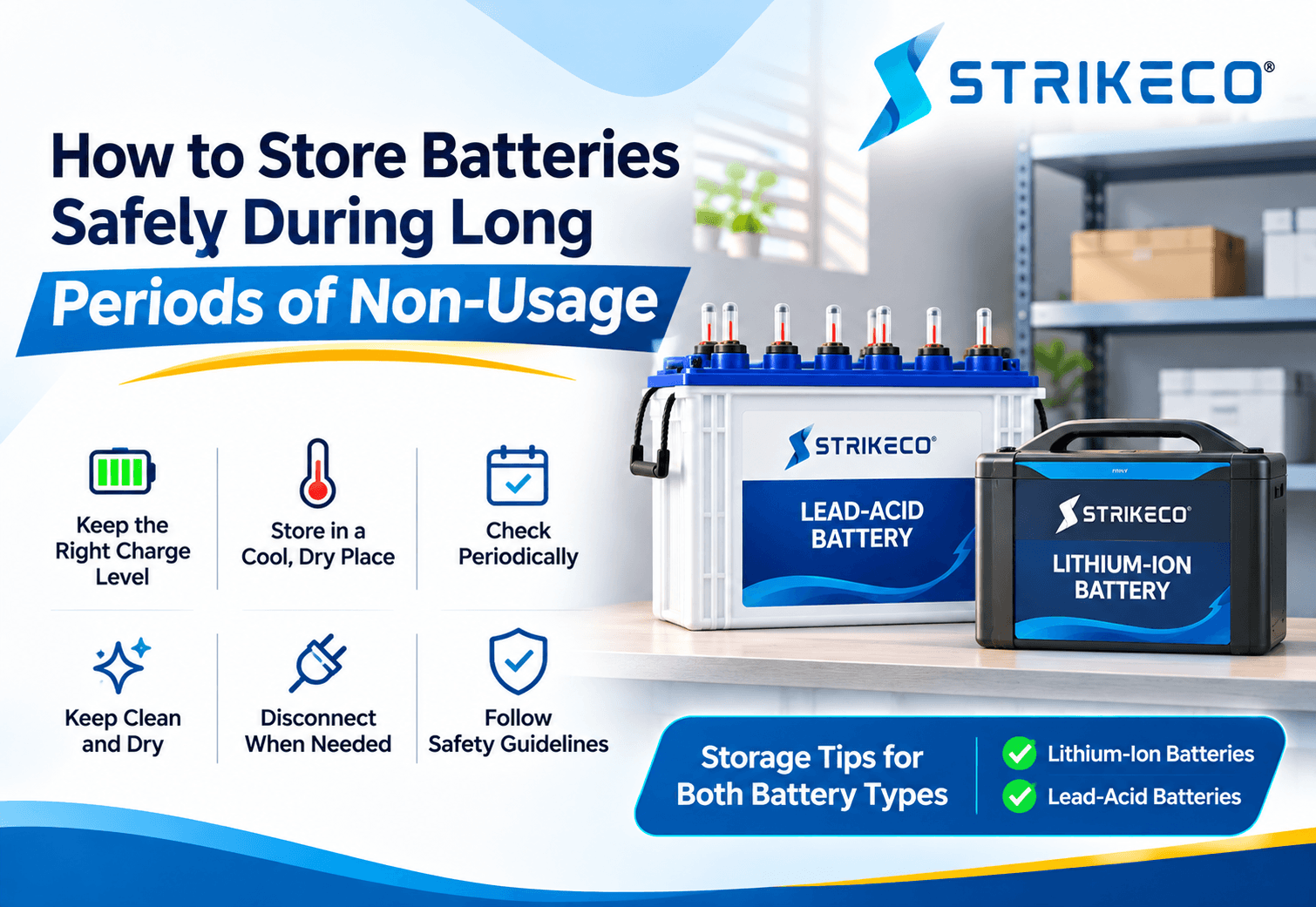
How to Store Batteries Safely During Long Periods of Non-Usage
Batteries are used in many everyday applications, from electric scooters and vehicles to home inverter systems and industrial equipment. However, not every battery remains in regular use throughout the year. Sometimes, batteries are kept unused for several weeks or months due to travel, seasonal requirements, equipment shutdowns or changes in usage.
Storing a battery without proper preparation can affect its performance, reduce its lifespan and, in certain situations, create safety risks.
Even when disconnected, batteries can gradually lose their charge. Temperature, humidity, storage conditions and battery chemistry all influence how well a battery performs after a long period of inactivity.
Whether you use a lithium-ion battery or a lead-acid battery, understanding the correct storage practices can help protect your investment.
In this guide, we explain how to prepare batteries for long-term storage, the precautions to follow and how to maintain them during periods of non-usage.
1. Why Is Proper Battery Storage Important?
A battery does not stop ageing simply because it is not being used.
Most rechargeable batteries experience a process called self-discharge. This means they gradually lose stored energy even when disconnected from equipment.
If a battery remains unused for an extended period without appropriate care, several problems may develop:
- Reduced available battery capacity.
- Difficulty accepting or holding a charge.
- Increased internal resistance.
- Sulphation in lead-acid batteries.
- Faster ageing due to excessive temperatures.
- Potential safety risks if damaged batteries are stored improperly.
The effects vary depending on the battery chemistry and its condition.
Proper storage helps minimise these problems and makes it easier to return the battery to service when required.
2. Clean and Inspect the Battery Before Storage
Before storing a battery, inspect its physical condition.
Dust, moisture, corrosion and damaged connections can create problems during storage and when the battery is used again.
Check the following:
- Look for cracks, dents or physical damage.
- Inspect the battery terminals for corrosion.
- Check for electrolyte leakage in applicable lead-acid batteries.
- Look for swelling or deformation in lithium-ion battery packs.
- Ensure that the battery casing is clean and dry.
- Check the cables and connectors for damage.
If a lithium-ion battery is swollen, leaking, unusually hot or physically damaged, do not store or charge it as if it were a normal battery. Keep it away from people and combustible materials and contact an authorised battery service or disposal provider for guidance.
For lead-acid batteries, any leakage or casing damage should also be assessed by a qualified technician.
Never open or attempt to repair a sealed battery pack yourself.
3. Store the Battery at the Correct Charge Level
One of the most important parts of long-term battery storage is preparing it to the appropriate charge level.
However, the ideal storage charge differs between lithium-ion and lead-acid batteries.
Lithium-Ion Batteries
Lithium-ion batteries are commonly used in electric scooters, portable equipment and other electric mobility applications.
For long periods of non-usage, many manufacturers recommend storing lithium-ion batteries at approximately 40%–60% charge. Some official safety guidance recommends around 50%.
This helps avoid keeping the battery at either an extremely high or very low charge level for an extended period.
Recommended practices include:
- Avoid storing the battery completely discharged.
- Avoid leaving it fully charged for months.
- Follow the manufacturer’s recommended storage charge.
- Check the charge level periodically.
- Recharge to the recommended storage level when necessary.
For example, Health Canada’s lithium-ion battery safety guidance recommends storing batteries at approximately 50% charge and checking them every three months.
Lead-Acid Batteries
Lead-acid batteries have different storage requirements.
Unlike lithium-ion batteries, lead-acid batteries should generally be stored fully charged.
Leaving a lead-acid battery partially discharged for a long period can cause sulphation. This occurs when lead sulphate crystals form on the battery plates and become difficult to reverse, potentially reducing battery capacity.
Recommended practices include:
- Fully charge the battery before storage.
- Avoid leaving it discharged for extended periods.
- Check its condition periodically.
- Recharge according to the manufacturer’s instructions.
- Maintain electrolyte levels in applicable flooded battery models.
The exact maintenance and recharge schedule depends on the battery type, temperature and manufacturer’s recommendations.
4. Choose a Cool, Dry and Well-Ventilated Storage Location
Temperature plays an important role in battery health.
Excessive heat can accelerate chemical ageing and increase self-discharge. Moisture can also damage terminals and electrical connections.
Choose a suitable storage location with the following characteristics:
Cool Environment: Keep batteries away from direct sunlight, hot roofs and other heat sources.
Dry Conditions: Avoid damp rooms and locations where water may collect.
Good Ventilation: Lead-acid batteries, particularly flooded models, can release gases during charging. Store and charge them in a suitably ventilated area.
Stable Temperature: Avoid locations exposed to extreme temperature fluctuations.
Protection from Physical Damage: Keep batteries away from heavy objects, falling equipment and areas where they may be knocked over.
For lithium-ion batteries, avoid storing them in hot vehicles or direct sunlight. Follow the manufacturer’s recommended temperature range.
5. Disconnect Batteries from Equipment When Appropriate
When a battery is connected to equipment, some electrical components may continue drawing a small amount of power even when the equipment is switched off.
This is sometimes called parasitic or standby discharge.
Over several weeks or months, this additional power consumption can reduce the battery’s charge.
If the equipment will remain unused for a long period, check the manufacturer’s instructions to determine whether the battery should be disconnected.
Consider these precautions:
- Switch off the equipment before disconnecting the battery.
- Follow the correct disconnection procedure.
- Ensure terminals cannot accidentally touch conductive materials.
- Protect exposed connections.
- Avoid disconnecting batteries if doing so could affect safety systems or equipment settings.
For electric scooters and vehicles, use the manufacturer’s recommended storage procedure rather than attempting to remove or disconnect the battery pack independently.
6. Check the Battery Periodically During Storage
Long-term storage does not mean the battery should be ignored until it is needed again.
Periodic inspections help identify charge loss, physical damage and other potential problems.
For Lithium-Ion Batteries
Check the battery periodically for:
- Charge level.
- Swelling or deformation.
- Unusual smell.
- Leakage or physical damage.
- Signs of overheating.
Health Canada recommends checking long-term stored lithium-ion batteries every three months and restoring the charge to approximately 50% when needed.
For Lead-Acid Batteries
Check:
- Open-circuit voltage, where appropriate.
- Electrolyte levels in serviceable flooded batteries.
- Terminal condition.
- Signs of corrosion or leakage.
- Whether the battery requires recharging.
Lead-acid batteries gradually self-discharge. Extended storage without recharging can lead to sulphation and permanent capacity loss.
The inspection and recharge interval should follow the manufacturer’s guidance.
7. Understand the Storage Requirements of Different Battery Types
Not all batteries can be stored using the same procedure.
The two common rechargeable battery technologies used in many mobility and backup applications have different requirements.
Lithium-Ion Batteries
Lithium-ion batteries are widely used in modern electric scooters and other electric mobility products.
Important storage precautions include:
- Store at the manufacturer’s recommended charge level.
- Keep away from direct sunlight and excessive heat.
- Protect the battery from moisture and physical damage.
- Avoid storing completely discharged batteries.
- Inspect periodically for swelling or other damage.
- Use only manufacturer-approved charging equipment.
If you are exploring different mobility battery options, you can learn more about EV Batteries in India.
Lead-Acid Batteries
Lead-acid batteries are commonly used in home inverter systems, backup applications and certain electric mobility products.
Important storage precautions include:
- Fully charge before extended storage.
- Store upright in a suitable location.
- Keep terminals clean and protected.
- Avoid prolonged storage in a discharged condition.
- Check electrolyte levels in applicable flooded batteries.
- Recharge periodically as recommended by the manufacturer.
You can also explore Lead acid batteries in India to understand their different applications.
8. Common Battery Storage Mistakes to Avoid
Some storage mistakes can reduce battery performance even when the battery is not being used.
Here are a few practices to avoid.
1. Storing a Battery Completely Discharged
A deeply discharged battery may experience permanent capacity loss if left unused for an extended period. This is particularly important for lead-acid batteries.
2. Leaving Batteries in Direct Sunlight
Excessive heat can accelerate battery ageing. Avoid storing batteries in exposed outdoor areas or hot vehicles.
3. Ignoring Periodic Inspections
Batteries can lose charge during storage. Check their condition at intervals recommended by the manufacturer.
4. Storing Damaged Batteries
Swollen, leaking or physically damaged batteries should not be treated as normal storage items. Seek professional advice on safe handling.
5. Using an Incompatible Charger
Always use charging equipment designed for the specific battery chemistry and model.
6. Storing Batteries Near Flammable Materials
Keep batteries away from paper, fuel, chemicals and other combustible materials. Maintain a suitable storage area with appropriate safety precautions.
7. Mixing Different Battery Types
Do not connect or store batteries in a way that allows their terminals to come into accidental contact. Keep loose batteries protected and separated.
9. How to Prepare a Battery Before Using It Again
After several weeks or months of inactivity, do not immediately put a stored battery into demanding use without checking its condition.
Follow these steps:
Step 1: Inspect the Battery
Check the casing, terminals, connectors and cables for physical damage, leakage or corrosion.
Step 2: Check the Charge Level
Measure the battery condition using an appropriate method or diagnostic equipment.
Step 3: Recharge if Required
Use the correct charger and follow the manufacturer’s charging instructions.
For lead-acid batteries, check electrolyte levels if the model is serviceable. Do not open sealed batteries.
Step 4: Check for Unusual Heating
During charging, watch for unusual temperature increases, swelling, leakage or abnormal smells.
Stop charging if anything appears abnormal.
Step 5: Test Battery Performance
If the battery is used in an inverter, electric scooter or other equipment, check its performance before relying on it for regular operation.
If it does not hold charge or shows warning indicators, have it inspected by a qualified technician.
10. Battery Storage Checklist
Use this simple checklist before storing a battery for an extended period.
| Storage step | Lithium-ion battery | Lead-acid battery |
|---|---|---|
| Inspect for physical damage | Required | Required |
| Clean and dry exterior | Recommended | Recommended |
| Prepare charge level | Usually around 40%–60%, if manufacturer permits | Fully charged |
| Disconnect from equipment | If recommended | If recommended |
| Store away from direct sunlight | Required | Required |
| Choose a dry location | Required | Required |
| Ensure suitable ventilation | Follow manufacturer guidance | Important, especially for flooded models |
| Periodic inspection | Check charge and physical condition | Check voltage, electrolyte where applicable, and charge |
| Recharge during storage | Restore recommended storage charge when needed | Recharge as recommended to prevent sulphation |
Always refer to the battery manufacturer’s storage instructions because requirements can vary by chemistry, model and application.
Final Thoughts
Proper battery storage is essential for maintaining performance and avoiding unnecessary damage during long periods of non-usage.
The most important thing to remember is that different battery technologies require different storage practices.
Lithium-ion batteries are generally stored at a moderate charge level, while lead-acid batteries should generally be kept fully charged to reduce the risk of sulphation.
Along with the correct charge level, choosing a cool and dry location, inspecting the battery periodically and using compatible charging equipment can help protect battery health.
Whether you use a battery for an electric scooter, home inverter or industrial application, following the manufacturer’s storage recommendations is the best way to prepare it for future use.
Frequently Asked Questions (FAQs)
1. Can a battery be stored without using it for several months?
Yes, but the correct storage procedure depends on the battery type. Both lithium-ion and lead-acid batteries require appropriate charge levels, suitable environmental conditions and periodic inspections.
2. Should lithium-ion batteries be fully charged before long-term storage?
Generally, no. Many manufacturers recommend storing lithium-ion batteries at a moderate charge level, often around 40%–60%. Follow the specific manufacturer’s instructions.
3. Should lead-acid batteries be fully charged before storage?
Yes. Lead-acid batteries should generally be stored fully charged. Leaving them discharged for long periods can cause sulphation and reduce their capacity.
4. How often should stored batteries be checked?
The inspection schedule depends on the battery chemistry and manufacturer’s instructions. For example, Health Canada recommends checking long-term stored lithium-ion batteries every three months.
5. Can I store a battery in direct sunlight?
No. Direct sunlight and excessive heat can accelerate battery ageing. Choose a cool, dry location away from direct sunlight.
6. What happens if a lead-acid battery remains unused for a long time?
It gradually loses charge through self-discharge. If it remains discharged, sulphation can develop on the plates and reduce its ability to hold charge.
7. Should I disconnect my inverter battery when going on a long vacation?
Follow the inverter and battery manufacturer’s instructions. If disconnection is recommended, ensure it is done safely. Also consider any equipment that may require continuous power.
8. Can a swollen lithium-ion battery be stored for later use?
A swollen lithium-ion battery should not be treated as a normal battery. Do not charge, puncture or attempt to repair it. Keep it away from combustible materials and contact an authorised service or disposal provider.
9. Can I use a battery immediately after long-term storage?
Inspect it first, check its charge and recharge if necessary using the correct charger. If it shows unusual behaviour or physical damage, have it professionally inspected before use.
10. Does battery storage affect its lifespan?
Yes. Incorrect charge levels, excessive temperatures and poor storage conditions can accelerate battery degradation. Following the manufacturer’s storage recommendations helps minimise these risks.
