
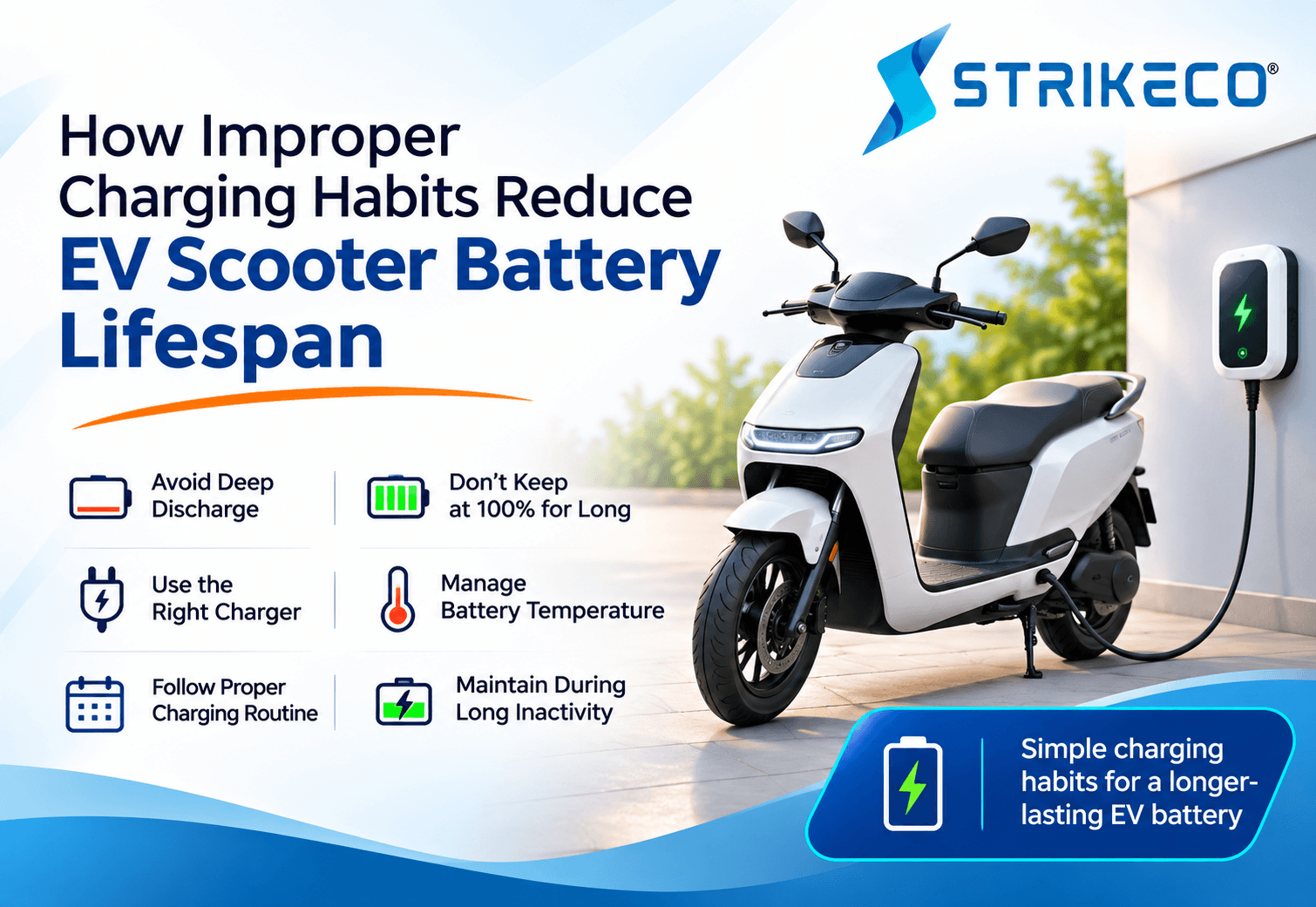
How Improper Charging Habits Reduce EV Scooter Battery Lifespan
Electric scooters are becoming an increasingly popular transportation option in India. They offer convenient daily commuting, lower running costs and reduced dependence on conventional fuels. However, one important factor that influences the overall ownership experience is battery performance.
An electric scooter battery gradually loses capacity as it ages. While this is a natural process, certain charging habits can accelerate battery degradation and reduce the distance a scooter can travel on a full charge.
Many EV owners unknowingly follow charging practices that put unnecessary stress on their batteries. Frequently allowing the battery to drain completely, using an incompatible charger or exposing it to excessive heat can affect its long-term performance.
Understanding these habits can help electric scooter owners maintain battery health, improve reliability and get better long-term value from their vehicles.
Let’s explore how improper charging habits affect EV scooter batteries and what you can do to avoid them.
1. Frequently Allowing the Battery to Drain Completely
One common mistake among electric scooter owners is waiting until the battery reaches almost 0% before charging it.
Repeated deep discharges can put additional stress on battery cells, particularly lithium-ion batteries. Over time, this may contribute to faster capacity degradation.
Modern electric scooters generally include a Battery Management System (BMS) that monitors battery voltage and provides protection against certain operating conditions. However, this does not mean repeatedly draining the battery completely is a good charging practice.
How to avoid this:
- Recharge the battery before it reaches an extremely low level.
- Avoid making complete discharge a regular habit.
- Follow the recommended charging range in your scooter’s manual.
- Do not leave the battery completely discharged during long periods of inactivity.
Maintaining a suitable charge level can help reduce unnecessary stress on the battery.
2. Keeping the Battery at 100% Charge for Extended Periods
Charging an electric scooter to 100% is sometimes necessary, especially before a long journey. However, keeping a lithium-ion battery at full charge for extended periods can contribute to battery ageing.
Lithium-ion batteries experience greater chemical stress when maintained at very high charge levels, particularly when combined with high temperatures.
For everyday commuting, some manufacturers recommend charging to a lower level rather than keeping the battery fully charged continuously.
How to avoid this:
- Follow the charging recommendations provided by your scooter manufacturer.
- Avoid leaving a fully charged battery connected to the charger unnecessarily.
- If your scooter supports a charging limit, use the recommended setting for regular commuting.
- Charge fully when required for longer journeys, according to the manufacturer’s instructions.
Remember that charging recommendations can differ depending on battery chemistry and battery management systems.
3. Using an Incorrect or Incompatible Charger
Not all electric scooter chargers are interchangeable.
Different batteries require specific voltage, current and charging characteristics. Using an incompatible charger can result in improper charging, excessive heat or damage to battery components.
Even if another charger has a connector that fits your scooter, it does not necessarily mean that it is electrically compatible.
How to avoid this:
- Always use the original charger supplied with your scooter or an approved replacement.
- Check voltage and current compatibility before replacing a charger.
- Avoid cheap, unverified charging accessories.
- Inspect charger cables and connectors regularly.
- Stop using damaged chargers and seek professional assistance.
Using the correct charger is one of the simplest ways to support battery safety and reliable performance.
4. Charging Immediately After a Long Ride
During a long journey, an electric scooter battery may become warm due to energy consumption and operating conditions.
Connecting the charger while the battery is still unusually hot may expose it to additional thermal stress.
Temperature is an important factor in lithium-ion battery performance. Charging outside the manufacturer’s recommended temperature range can affect battery health and safety.
How to avoid this:
- Allow the battery to cool naturally after demanding rides.
- Avoid charging when the battery is unusually hot.
- Charge in a cool, dry and well-ventilated location.
- Follow the temperature limits specified in the scooter manual.
There is no universal waiting time for every scooter. The appropriate charging conditions depend on the battery and manufacturer instructions.
5. Charging the Battery in Direct Sunlight or Hot Areas
High temperatures can accelerate the chemical ageing of lithium-ion batteries.
In India, electric scooters are often parked outdoors, sometimes under direct sunlight for several hours. Charging a battery in an excessively hot environment can increase thermal stress.
Repeated exposure to high temperatures may gradually reduce usable battery capacity.
How to avoid this:
- Park your scooter in a shaded or covered area whenever possible.
- Avoid charging in direct sunlight.
- Choose a dry, ventilated charging location.
- Keep batteries away from heat sources.
- Allow a hot battery to cool naturally before charging.
Temperature management is particularly important during hot summer months.
6. Leaving the Charger Connected Unnecessarily
Many modern electric scooters have a Battery Management System that helps control charging and protects the battery from certain electrical conditions.
However, this does not mean owners should leave their scooters connected to the charger indefinitely.
Unnecessary prolonged charging can expose the charging equipment and electrical connections to avoidable operating stress. It is also important to follow the manufacturer’s instructions rather than assuming that every battery system behaves identically.
How to avoid this:
- Monitor the charging process.
- Disconnect the charger after charging is complete, as recommended by the manufacturer.
- Avoid leaving the scooter charging for several days.
- Check for unusual heating, smells or charging interruptions.
- Use a safe charging location away from combustible materials.
Never rely on the BMS as a replacement for proper charging practices.
7. Ignoring Battery Charging Requirements During Long Periods of Inactivity
Electric scooters are sometimes left unused for several weeks due to travel, work schedules or other reasons.
However, batteries gradually lose charge even when the scooter is switched off.
If a battery remains at a very low charge level for an extended period, it may become deeply discharged and difficult to recover.
The ideal storage charge level depends on the battery chemistry and manufacturer recommendations.
How to avoid this:
- Check the battery level before storing the scooter.
- Follow the manufacturer’s recommended storage charge.
- Keep the vehicle in a cool and dry location.
- Check the battery periodically during extended inactivity.
- Avoid leaving the battery completely discharged.
For long-term storage, consult the scooter manual for the correct charging and maintenance schedule.
8. Understanding How Charging Habits Affect Different Battery Types
Not every electric scooter uses the same battery technology. Charging requirements can differ significantly depending on the chemistry.
Lithium-Ion Batteries
Lithium-ion batteries are widely used in modern electric scooters because of their energy density and relatively low weight.
Some important care practices include:
- Avoid repeated deep discharges.
- Minimise prolonged exposure to high temperatures.
- Use only compatible charging equipment.
- Follow the recommended charging limits.
- Store the battery according to manufacturer instructions.
Lead-Acid Batteries
Lead-acid batteries are used in some electric scooters and other electric mobility applications.
They have different charging requirements compared with lithium-ion batteries. In particular, repeatedly leaving a lead-acid battery partially discharged can contribute to sulphation, which reduces its ability to hold and deliver charge.
Some important care practices include:
- Use a charger specifically designed for the battery type.
- Avoid leaving the battery discharged for extended periods.
- Follow the recommended full-charging procedure.
- Check battery terminals and connections.
- Maintain the battery according to the manufacturer’s instructions.
If you are researching different battery technologies, you can explore EV Batteries in India to understand the available battery solutions.
You can also learn more about Lead acid batteries in India and their applications.
9. Signs That Your EV Scooter Battery May Be Losing Its Health
Even when an electric scooter is used regularly, its battery gradually ages. However, improper charging practices can contribute to faster performance deterioration.
Watch for these signs:
Reduced Riding Range: The scooter travels a shorter distance than it previously did with a similar riding pattern and charging level.
Longer Charging Time: Charging takes noticeably longer than usual or does not complete as expected.
Unexpected Battery Percentage Changes: The displayed charge level drops unusually quickly or behaves inconsistently.
Excessive Heating: The battery or charger becomes unusually hot during normal operation.
Frequent Charging Requirements: The scooter requires charging more frequently despite similar daily usage.
Battery Warning Indicators: The dashboard displays battery-related warnings or error messages.
These symptoms do not always indicate battery degradation. Problems with the charger, connections, BMS or other vehicle components may also be responsible.
If you notice swelling, unusual smells, smoke or excessive heat, stop using and charging the vehicle and contact an authorised service professional. Do not attempt to open or repair the battery pack yourself.
10. Best Charging Practices to Improve EV Battery Lifespan
Following a few simple habits can help maintain battery performance over time.
| Recommended practice | Why it matters |
|---|---|
| Use the original or approved charger | Ensures electrical compatibility |
| Avoid frequent deep discharge | Reduces unnecessary battery stress |
| Avoid prolonged storage at extreme charge levels | Supports better long-term battery condition |
| Charge in a cool, ventilated area | Helps manage heat |
| Allow a hot battery to cool naturally | Avoids charging under excessive temperature |
| Follow manufacturer charging limits | Supports safe and suitable charging |
| Check battery condition periodically | Helps identify potential problems early |
| Follow proper storage instructions | Prevents unnecessary discharge during inactivity |
It is also important to remember that battery lifespan depends on more than charging habits. Battery chemistry, manufacturing quality, riding conditions, temperature, maintenance and usage patterns all play a role.
Final Thoughts
An electric scooter battery is an important component that directly affects riding range, convenience and overall vehicle performance.
While gradual battery ageing is unavoidable, improper charging habits can accelerate capacity loss and affect long-term reliability.
Avoiding frequent deep discharges, using compatible chargers, managing battery temperature and following the manufacturer’s charging instructions can help maintain battery health.
Whether you use a lithium-ion or lead-acid battery, understanding its specific requirements is essential for proper care.
For businesses and consumers exploring battery solutions, understanding different battery technologies and their maintenance requirements can help support better purchasing and usage decisions.
Frequently Asked Questions (FAQs)
1. Does charging an electric scooter every day damage the battery?
No. Daily charging does not automatically damage an electric scooter battery. What matters is following the recommended charging procedure and avoiding unnecessary exposure to extreme charge levels and temperatures.
2. Is it bad to charge an EV scooter battery to 100%?
Charging to 100% is sometimes necessary, especially before longer journeys. However, keeping a lithium-ion battery at full charge for extended periods may accelerate ageing. Follow the manufacturer’s recommendations.
3. Can I charge my electric scooter overnight?
Charging overnight without supervision is not recommended as a general safety practice. Follow the manufacturer’s instructions and use a safe charging location. Avoid leaving the battery connected unnecessarily after charging is complete.
4. Should I wait before charging my electric scooter after riding?
If the battery is unusually warm after a long or demanding ride, allow it to cool naturally before charging. Follow the manufacturer’s temperature guidelines.
5. Can using a different charger reduce battery lifespan?
Yes, an incompatible charger can cause improper charging, excessive heat or damage. Always use the original charger or an approved replacement.
6. What happens if an EV scooter battery reaches 0%?
A deeply discharged battery may experience capacity loss or become difficult to recharge. Avoid repeatedly allowing the battery to reach an extremely low level.
7. Does hot weather affect electric scooter battery life?
Yes. Prolonged exposure to high temperatures can accelerate lithium-ion battery ageing and may affect charging performance. Parking in shaded areas and charging under suitable temperature conditions can help.
8. How should I store my electric scooter if I am not using it?
Follow the manufacturer’s recommended storage charge level. Keep the scooter in a cool, dry place and check the battery periodically to prevent excessive discharge.
9. Are lithium-ion and lead-acid batteries charged in the same way?
No. They have different charging characteristics and require compatible chargers and maintenance practices. Always follow the specifications for the particular battery chemistry.
10. How can I identify an EV scooter battery problem?
Reduced riding range, unusual heating, inconsistent charge readings, charging interruptions and battery warning indicators may suggest a problem. Have the battery and charging system inspected by an authorised technician.
